
By Jenna Outcalt | UConn Journalism
December 10, 2025
What can be done about food insecurity in cities? It’s a question that vexes many, but the steps taken to address often seem insignificant or ineffective. However, some community members are stepping up to create a more sustainable and affordable food system in their city. I spoke with members and partners of Levo International, a nonprofit using land directly in the city to create farms in the community.
Transcript:
*Cars driving by*
[JENNA] I’m just over a mile from the highway in North Hartford, standing in what for a long time a vacant lot. Now, it’s overflowing with fruit and vegetables, all created by a Hartford-based nonprofit working to fight food insecurity.
[MUSIC]
[JENNA] Food insecurity is on the rise in the United States. According to the USDA, about 18.8 million people are in food deserts, meaning they are low-income and don’t have easy access to a grocery store. In Connecticut alone, over one in seven residents struggle with food insecurity.
Levo International, developed by UConn graduate Christian Heiden, has created a farm directly in the city, and they’re not stopping there. Levo officially started in 2016, when Christian had a very ambitious idea for his Eagle Scout project.
[CHRISTIAN HEIDEN] I basically stumbled in the backyard of my Scout Masters house on simplified hydroponics in particular, and he had done it in the Dominican Republic close to 30 years ago now, and he explained the benefits and how simple it was to build and operate, and I was like, I’ve never even heard of this. This is nowhere. Why is this not everywhere? Um, and so that was kind of where we started.
I was like let me let me build a hydroponic. It worked in DR so let me build a hydroponic greenhouse in Haiti. Uh, and that was kind of my, I was like that’ll be my Eagle Scout project. Turns out the Boy Scouts, not huge fans of the idea of sending a 16-year-old to Haiti. So it ended up that I did my official project for my high school in West Hartford and then went down separately with my father and my brother.
We started working with this Iowan-based missionary organization, Many Hands for Haiti, down there and that’s where we started um working. And you know, fell in love with the country and the people and most excitingly is our systems worked. Uh and so that’s kind of where it took off from as we were like, “Okay, this actually works. This has huge potential because of the water saving, because of the, you know, the readily accessible materials, uh we can make this work here.”
[MUSIC]
[JENNA] So, what does simplified hydroponic farming actually look like? Christian took me outside to show me the rows of horizontal pipes lined up on wooden frames, each one blossoming with food.
[CHRISTIAN] So, every system is the same. So, there’s — all it is, there’s a bin at the base, which is kind of like a 27-gallon Home Depot tote. The water gets pumped up to the top pipe, and then it gravity feeds down and splashes back into the bin. And so the idea is basically that there’s always water in the pipes.
So like right now the pump’s not running in this system, but these pepper plants still have access to water. And that’s the model that we’ve been developing for Haiti, is that you can run the pump only a couple times a day and still have really good production.
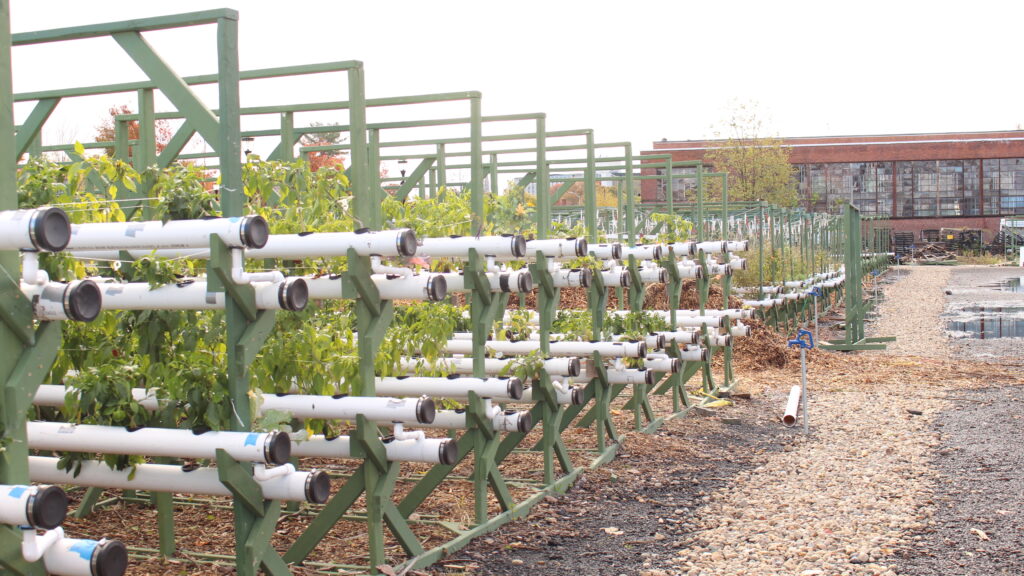
All these frames are built by people. A lot of them were built by volunteers or by our workforce development program this summer. Uh, so they’re very easy to make. So anybody can make them. You need some drills, some 2x4s and we put them together. So we could build a farm of this size really within a couple months.
The incredible thing about these tower gardens is that they’re super flexible on what you can do. So, you know, we’re looking at parsley, but if you go and you look at, you know, just walk down this row of systems.
If you look, right, you can see you’ve got broccoli, we’ve got peppers, right, four different types of peppers. There’s three different types of systems that we do here. So you’ve got uh six pipe systems, which are for your leafy greens, your lettuces, your collard greens, things like that. And that’s 218 plants in one 20-ft system. So you can basically produce about 36 heads of lettuce a week. Uh out of one of our hydroponic systems. We’ve got about 100 here.
[JENNA] For the first few years, Levo was mainly focused on Haiti. Although there are still continuing projects there, the organization has expanded both internationally and back home in Hartford.
[CHRISTIAN] We’ve done some work in Oaxaca, Mexico and working some school systems in Oaxaca and we work now in Puerto Rico and Yabucoa. And then in the US, for the last 5 years, we’ve been playing around with first what we did in Haiti as a backyard model of hydroponics. But we realized very quickly that if we wanted to fix the food system, we needed to actually get into the farming space.
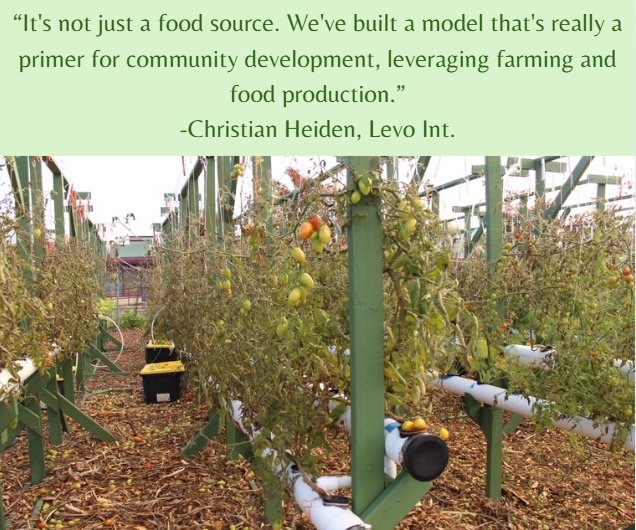
And so, then we for the last couple years have basically ended up developing our own approach to urban farming, scaling up simplified hydroponics and building, basically, this really exciting model that doesn’t just — it’s not just a food source. We’ve built a model that’s really a primer for community development, leveraging farming and food production. So, we can very quickly and effectively beautify, create employment opportunities, and create food access, and uh you know, just really uplift a community and education and workforce development, and we can do it at a cost point that’s just insane.
[JENNA] Levo distributes its food partially through a community-supported agriculture farm share or CSA, where people pay upfront for a share of the produce. They also have a farm stand that they’re looking to expand into a year-round market. The rest of the food is donated.
[CHRISTIAN] The goal is not to donate, is to is to get it in people’s hands buying it because that creates a sustainable revenue stream for us that keeps this economically sustainable. The risk of growing and donating is just that you — if you run out of grant money or donations, you can’t give anyone anything. And so the idea is can we lower that price point? Can we subsidize and underwrite it with sales to the suburban communities to make it affordable and accessible for the community here in the North End of Hartford?
[CUREENE BLAKE] I take this really seriously because I was raised in Jamaica and my mother farmed, and it was her farm that initially supported us to go to school before she got a job in the in the public sector.
[JENNA] That’s Cureene Blake. Her daycare in Hartford partners with Levo to teach the kids about agriculture and connect them to the food they eat.
[CUREENE] We’ve done it every year. Every year we have, since we’ve got our system, we’ve done two or three crops with them providing the technical support, troubleshooting any problem. Anytime I call, they’re always there.
[SOUND EFFECTS] *children playing, shouting*
[CUREENE] Day care, childcare in Connecticut is going to a whole different process and different levels now. And so I’m envisioning that soon we can do something like this in any family childcare. The land space that you need is minimal. The, um, the amount of daily attention is minimal, but the experience, the knowledge, the understanding is phenomenal.
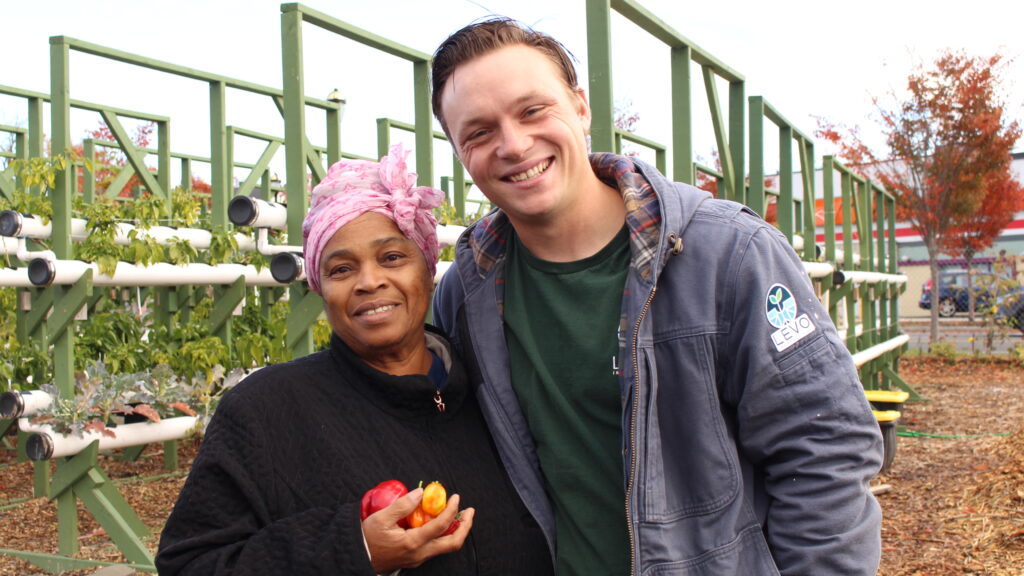
They go inside with their one leaf of lettuce, their little plastic fork, their two tomatoes that they picked, cut them up. And guess what? Children who don’t normally eat vegetables are eating it because they grew it. And so, it gives them, even at that tender age, a level of experience and a broader understanding that you could ever get from a book or from somebody actually telling you that this is valuable to you.
[MUSIC]
[RON WILLIAMS] My name is Cornelius Williams. I’m originally from the Caribbean, the Caribbean Island of St. Lucia, and I moved here in 2022. Um, I’m now the farming director for Levo International, but I actually started off as a volunteer.
[JENNA] Cornelius, who goes by Ron, has a background in agricultural education and management. Now, he keeps the farming operations on track at Levo.
[RON] So, my biggest role is to ensure that everything stays alive and productive. And that the team generally knows where we’re headed and what we’re doing. But most of it is as we have several locations including our clients, the hospitals, other companies that we work with. There I can oversee to ensure that they themselves are doing fine as well.
Well, we’ve found out early on in, when I started with level is that a person just thinks everything comes from the store. They have no idea the process it takes to get fresh produce to their homes. Um but we’re here trying to make it — we’re making it easier so anyone can grow something for themselves to live a happier healthier life.
[JENNA] Levo’s current site in Hartford was vacant for 25 years before they moved in. Since their lease began in January, they’ve made it into a fully functioning farm.
[CHRISTIAN] Our pitch to the community and increasing buy-in is that, you know, people are realizing what we can do all over the city and in their community.
So, that’s, you know, I think the revitalization and the momentum is the is the big thing. And then providing opportunities for community members, every month. There’s some kind of more individualized community benefits, but then, you know, we are transforming the community, and we’re doing it at a speed that nobody would have thought possible.
I think the thing that’s really exciting that Levo’s developed is this like, very inclusive model where we can do a whole lot with very little and it’s not — people think of us as a hydroponics company and we are, but we’re significantly more than that.
Our model is a way for North Hartford residents to help lift themselves and their community out of poverty, grow healthy food for the community, beautify the community, right, in a way that’s not risky for the immediate community, but also then still can bring in that development long-term that we want to see. It’s just a really exciting model that we anticipate not only having a huge impact here in the North End of Hartford, but being a model that we can replicate everywhere.
[MUSIC]
Social Media Promotions:
Check out Levo’s website here. Read news articles about them here and here.