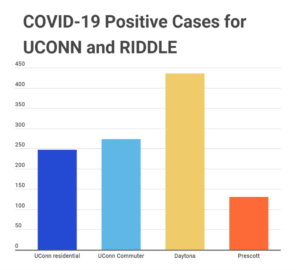
Graph of Positive COVID-19 cases for UConn and Riddle
Embry Riddle Aeronautical University, in Daytona Beach, Florida, and Prescott Arizona, is handling the pandemic differently than the University of Connecticut According to Nathan Hawk, a residential freshman at the Daytona Beach campus, said about the testing on campus, “Now and then they’ll do tests but most of the time it is at your discretion.” Hawk also says, “I try to go every two weeks at least.”
Compared to UConn the testing for commuter students, if they have any classes that meet in person, they had to get tested for COVID-19 every week of February. UConn has also made it starting on March 1 that students will be randomly selected throughout the spring semester. The Student Health and Wellness, SHAW, website says “Off-campus students with an on-campus commitment will have access to five (5) self-requested surveillance tests in addition to any testing requested by SHaW. Off-campus students without an on-campus commitment will have access to three (3) self-requested surveillance tests in addition to any testing requested by SHAW.” This means that any students who are concerned that they might have caught the Coronavirus can get tested through the school instead of getting tested through a drive-up testing site.
For both schools, this semester is better than last semester because they knew what they were doing they figured out the problems from the fall semester and fixed them, so testing was easier and smoother. Hawk said this about Riddle “I feel like they are doing better this semester than they were last because the COVID test things are more often…” This is a good thing because that can lead Riddle to know where the hotspots are if there are hot spots. When asked if he were to change one thing about how Riddle is handling the pandemic Hawk says “I think it would be a good idea if everyone tested once a month…” If Riddle did test once a month then they would help protect the students, staff, and faculty better. UConn did this with the commuter students and did random pool testing for the residential students. Pool testing if you were not aware is when you collect a whole residential hall and it takes a spit test and then all of the spit goes into a test tube and gets shaken around and it will tell whether or not that residential hall has COVID or not.
Hall Memorial School Logo. / Willington Public Schools
WILLINGTON- Theater Director and music teacher Jason Phillips told the Board of Education on Tuesday about how the drama club has been able to perform during the pandemic.
“The biggest challenge in the script was how people move on the stage and different settings and stuff. So, the challenge was how do you how do you get the people to move while they are on a Zoom screen,” he said. “The solution we used was adapting some of the movement by looking and reaching through screens.”
What they ended up doing was getting a phone that looked similar and in rehearsal, one person handed the phone to the left so the next person would go to the left and grab the phone to make it seem like they were in the same room. Another trick that they did was to darken the background to make it seem like the actors were in the woods at nighttime.
Since there is currently a pandemic going on, the students are having to do their performances over Zoom so they are missing the audience interaction that they would have gotten.
“The hardest part is the audience response,” Phillips said. “Normally when you would act you have the audience laugh or clap for you and the difficulty goes both ways. And the difficulty for the kids who are performing is that they are not getting the energy from their parents and vice versa for the audience — they don’t get to interact with the kids as much. So what I have done to alleviate that issue is doing these watch parties.”
During these watch parties the students would act out their scenes in front of their parents and Phillips and they would give applause or laugh at the scene that was going on. This helped the students feel as if they were performing their show in front of a live audience as they would have gotten had there not been a pandemic.
To help the students effectively do a scene together even though they are not in the same room, “the answer is rehearsals, to rehearse and to talk about it. A lot of characters, the kids in past shows have done have each played two characters, and they try to find a way to differentiate between the two,” said Phillips.
Somestudents have gotten creative with different backgrounds, costumes, and even accents to help the audience realize that the same actor or actress is playing two different characters. With the two different characters, they can have a backstory to help the students come up with the way that they are going to portray each of their characters. The pandemic has made differences between shows that Phillips has done in the past and with the new structure that they are having to perform their plays in.
The difference between the virtual shows and the live shows in the past is that they do not charge for seeing the play. The parents and the family of the actors also do not have to worry about driving out to the school to go see the performance they can just go to the Zoom link that the parents can find in the digital backpack, which is a way to send out important information and events to the parents, and from there the parents can send the link to other family members so they can all watch the performance on the day of the performance.
Upcoming events include a monologue workshop in mid-March and a performance of “She Kills Monsters” in May.
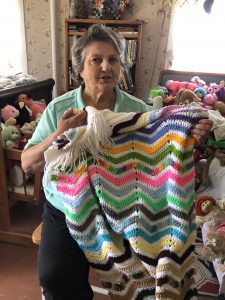
Karen Smith holding her pandemic blanket. / Madison Smith
During this pandemic and lockdowns, people have become bored with their everyday routines and are turning to a 17th-century cure: Crocheting.
Most people know more about knitting than crocheting. The difference between knitting and crocheting is, that knitting uses two while crocheting uses just one hook.
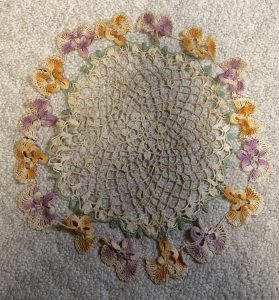
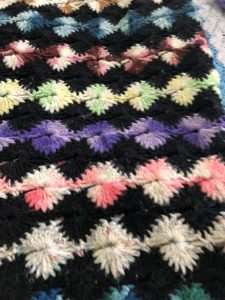
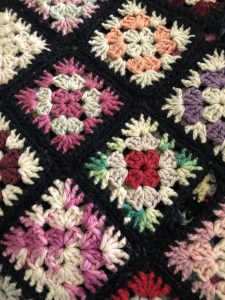
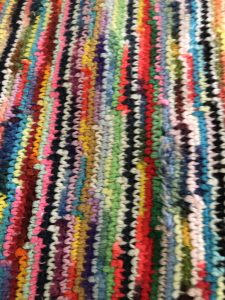
In crocheting there are multiple different patterns you can use. You have the granny square, which has multiple variations. And guess what? They do not even have to do a square. The granny square is small little pieces of yarn that get crocheted and then sewed together to make a blanket. As you can see in the two photos how different both granny squares are. Once you get the simple pattern down, you can then move on to the more intercut patterns like the granny square that Edith Arnold made that she did not turn into a blanket.
Grandma Edith’s granny square, which is 100 years old. Edith is Karen Smith’s grandmother. / Madison Smith
When beginning your crocheting journey, you should always start with a simple three-stitch pattern which is where you take the loop that you have after your knot and then you first start with your chain which is where you just keep taking your hook and putting a piece of yarn onto it.
Guinnevere Almquist, 20, who is from Willington, Connecticut, recently started to crochet. “My grandmother tried to teach me, but I couldn’t get it. Years later one of my best friends effectively taught me how to crochet.” Not everyone who learns how figures it out and it can get frustrating at times, but it can be achieved if you just keep practicing.
Almquist also said that she likes to make hats and is in the process of starting a new project. “I feel bored, then I turn on the TV and crochet and feel less bored.”
During a pandemic, people’s emotions start to run high due to the unknowns about the virus, especially in the early days of the pandemic. This is clearly shown in an elementary school in Rockford, Illinois. Ashley Robinson-Walker, who is a trauma therapist and founder of the crocheting club, says, “The crocheting club helps relax students from the stress and anxiety from everyday life and with the added stress of the pandemic.” With everything that is going on being stressed out is not a healthy way to live. Through this crocheting club, Robinson-Walker says, “It helps the girls who are having a hard time dealing with the stress and it helps them relax and talk about what is mentally hurting them.”
Mary Arnolds Granny square blanket. Mary is Karen Smith’s aunt./ Madison Smith
Crocheting is for everyone all you need is a hook, yarn, scissors, and a crocheting book or teacher to make whatever comes to mind. Julia Clark from the Willington Knitting Club says, “You can make anything you want out of yarn, you could make a sweater, scarf, or maybe some mittens, but it is all about patience because it takes time and some mistakes to be able to make a blanket or a scarf.” Just like how you make mistakes in life you can make mistakes in crocheting and miss a whole stitch and start your row all over again. Clark says, “The fun in crocheting is that you can be at any skill level and make a wonderful project, and if the power ever goes out you still have something to do till the power comes back on.”
Edith Arnold’s granny square blanket./ Madison Smith
Knitting Creations owner says, “During the pandemic, they made roughly double the amount that they made before the pandemic.” They are currently making about 54 thousand dollars in total sales per year of yarn, crocheting, and knitting accessories, books, and patterns to name a few things they sell. They are known for selling high-quality yarns from local and non-local vendors. They are also open to the public and have classes and workshops to help you learn how to crochet or knit and those cost ten dollars per two-hour sessions. The instructor of the class is there to make sure that the pattern matches the project. Knitting Creations is open Tuesday-Wednesday 10 a.m.-8 p.m., Thursday 10 a.m. — 6 p.m., Friday 10 a.m. — 5 p.m., and Saturday 10 a.m. — 4 p.m. in Somers, Connecticut.
Crocheting has been a pastime for so many people over the generations. This was the way most people had blankets to keep warm in the winter for an affordable price and to make ornaments for the Christmas tree and other decorations. It was also used as a tool to help the children learn how to make something that they would be proud of the result but also learning how to be careful not to tangle the yarn and to be able to make a mistake and figure out how to fix it and to ask for help when they did need help.
George Arnold’s blanket Karen Smith’s uncle. / Madison Smith
Crocheting can help you relax because you can just sit down turn on some music and just go through the motions of putting each stitch together and changing up the color every once and a while. You do not have to worry about the pressures of making sure that what you are making is someone else’s definition of perfect. You get to say that you made something instead of buying a similar crocheted blanket for $10 to $51 on Amazon when you can make it for $10 or less yourself. You do not have to crochet by yourself get your friends together, socially distanced, and sit and talk while having some background music, and in no time, you will have a scarf made within about two to three hours.
Crocheting can teach you some lessons that you did not even realize, for example, you could learn what your coping mechanism is for what you might be going through now. It is better than drinking your problems away or even smoking. Crocheting is a way for you to slowly get rid of some emotional problems in your life while keeping you healthy and it is a great way to make friends if you join a crocheting or knitting group. You do not have to keep the items that you make you can give them to friends and family as a present or you can donate them to hospitals, senior housing, homeless shelters, animal shelters, animal hospitals, NICU, basically anywhere that takes donations and gives them to people who need it. Once you get the hang of it you can also teach any of your friends who want to learn how to crochet so you guys can hang out and crochet together.
If you do not like crocheting after you have tried it you can always stop and either come back at a later point or you can donate the yarn and hook to a thrift store that sells craft items so that someone else can start their project even if they do not have all the money to get the items.
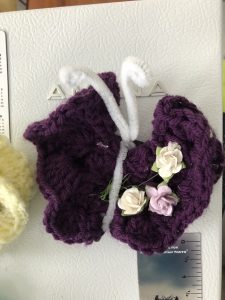
Crocheted butterfly made by Karen Smith. / Madison Smith
Karen Smith is the author’s grandmother, and all the pictures are of her creations and her families’ creations that have been passed down through the generations.