
By Kitan Arole, Amanda Gonzalez and Alexander Klancko | UConn Journalism
January 7, 2026
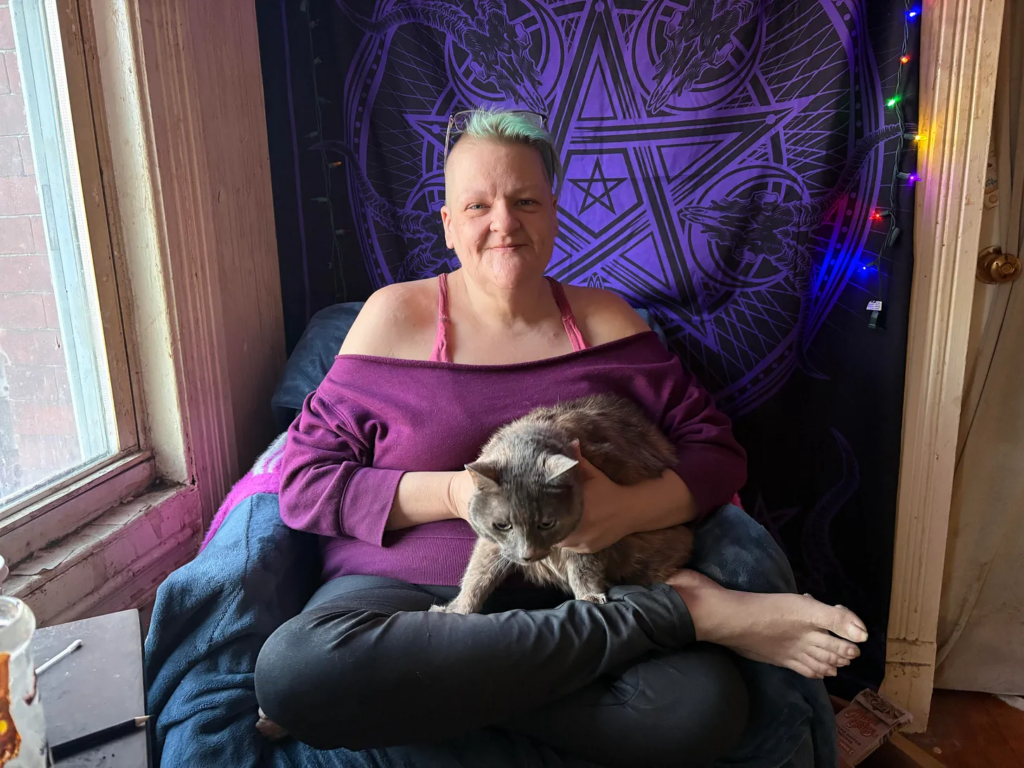
Kelly Verrier, who lives with her cat Henri in New Haven, said she sometimes must choose between feeding her pet or herself. Feeding Henri means she’ll go to bed hungry.
“I am one of those pet owners that make sure she’s fed before I am,” Verrier, 45, said. “Okay, she’s taken care of. That’s fine, I’ll eat tomorrow.”
Verrier is one of more than 516,000 people in Connecticut who struggle with hunger, according to Feeding America. That amounts to 1 in 7 Connecticut residents facing food insecurity, including 122,000 – or 1 in 6 – children in the state.
Verrier said that grocery store prices are too expensive, and that food banks are not always accommodating enough for her disabilities. She said she often lives off water and one meal a day.
The plight of food-insecure residents in the state became more visible in the fall when a 43-day shutdown of the federal government caused a pause in federal Supplemental Nutrition Assistance Program, or SNAP, benefits to the hungry. Food pantries and soup kitchens were inundated with residents in need — but also saw an outpouring of donations.
In addition, big changes to the system which are going into effect as a result of the Big Beautiful Bill Act may result in more people being forced off the system. Connecticut’s Department of Social Services estimates around 36,000 people in the state are at risk of losing food assistance under the changes, which expand work requirements.
Since the COVID-19 pandemic, the number of food insecure people in Connecticut has increased by 152,000, according to Connecticut Foodshare. In 2023, Connecticut’s statewide food insecurity rate was 14.3%, but the rate is much higher in some cities and towns, according to Map the Meal Gap, a nationwide resource produced by Feeding America.
In Hartford, the food insecurity hit 24.6% in 2025, followed by 23% in Waterbury, 22.5% in Bridgeport, 22.3% in New Haven and 21.8% in Windham, according to Foodshare.
“It’s affecting every town in Connecticut,” Olivia Giusto, Foodshare’s strategy and engagement coordinator, said. “It affects every town differently, but it is impacting the neighbors living in every town. It’s a big issue.”
According to Foodshare, increased food prices and stagnant wages are forcing families to make a choice between necessities.
“The wages [are] not matching up to what is needed really to thrive in Connecticut,” Giusto said. “When we think about cost of housing, cost of childcare, cost of food, cost of healthcare, all those things can make people be in situations where they have to make really tough decisions.”
Jason Jakubowski, the president and CEO of Foodshare, said the sudden halt in benefits last fall triggered an immediate surge in food assistance needs.
Jakubowski estimated that about 90% of the 360,000 residents in Connecticut on SNAP also use Foodshare-supported pantries or resources at some point during the year.
“We are seeing longer lines than we did during the pandemic,” Jakubowski said during the shutdown. “We had to hire 21 temporary staff members and rent eight additional trucks just to keep up.”
Jakubowski said Foodshare partners with roughly 600 pantries and community programs statewide, all of which saw increased demand as the shutdown unfolded.
“It was not easy to prepare because of the man-made nature of the shutdown,” he said. “As soon as it began, our board authorized $1 million in emergency spending so we could respond quickly.”
Dan Giacomi, who manages the SNAP program for the state Department of Social Services, said that families with children, senior citizens and people with disabilities make up a large share of the state’s SNAP recipients, placing some of the most vulnerable residents at risk when benefits were halted. He added that SNAP is closely tied to the state’s food economy.
“There is an economic multiplier to the SNAP benefit,” he said. “For every dollar that goes in, it could be up to $1.50 that it gives back to the community. It supports small grocers, farmers, farmhands — everyone along that chain.”
In Connecticut, Latino and Black people were disproportionately affected by food insecurity post-pandemic, according to Map the Meal Gap. In 2023, 30% of Latinos and 27% of Black people were food insecure while 10% of white people were food insecure in the Naugatuck Valley Planning Region, according to Map the Meal Gap.
State Rep. Geraldo Reyes Jr., D‑Waterbury, said he has seen the racial disparities in food security in the Naugatuck Valley region firsthand.
“Unfortunately, in the downturn, it’s hurting the people of color more than anybody else because they’re already at the bottom of the list to begin with,” he said.
Reyes said he has seen an uptick in residents visiting the St. Vincent DePaul Mission Soup Kitchen in Waterbury. About five years ago, he said St. Vincent DePaul was feeding about 100 to 120 people a day. Today, they are serving double the amount.
“I’ve sent so many people to the food shelter. Before, you never used to see people that had jobs in line,” Reyes said. “You do now. Now you see people that are working paycheck-to-paycheck, and you never used to see it.”
State Rep. Nick Menapace, D‑East Lyme, said federal cuts to SNAP are hurting many Connecticut residents, and the effects can be far-reaching.
“We know that … they’re going to be better engaged in society, if they don’t have to worry about having enough food to eat,” Menapace said. “This attempt to try and save money by making people suffer is not just immoral, but… it doesn’t make sense financially, and it doesn’t really make sense policy wise.”
During the shutdown, Lee Hay, director of the Cornerstone Foundation’s food pantry in the Rockville section of Vernon, said he saw people come in and cry, telling him they never thought they would have to ask for free food.
“It breaks your heart,” he said.
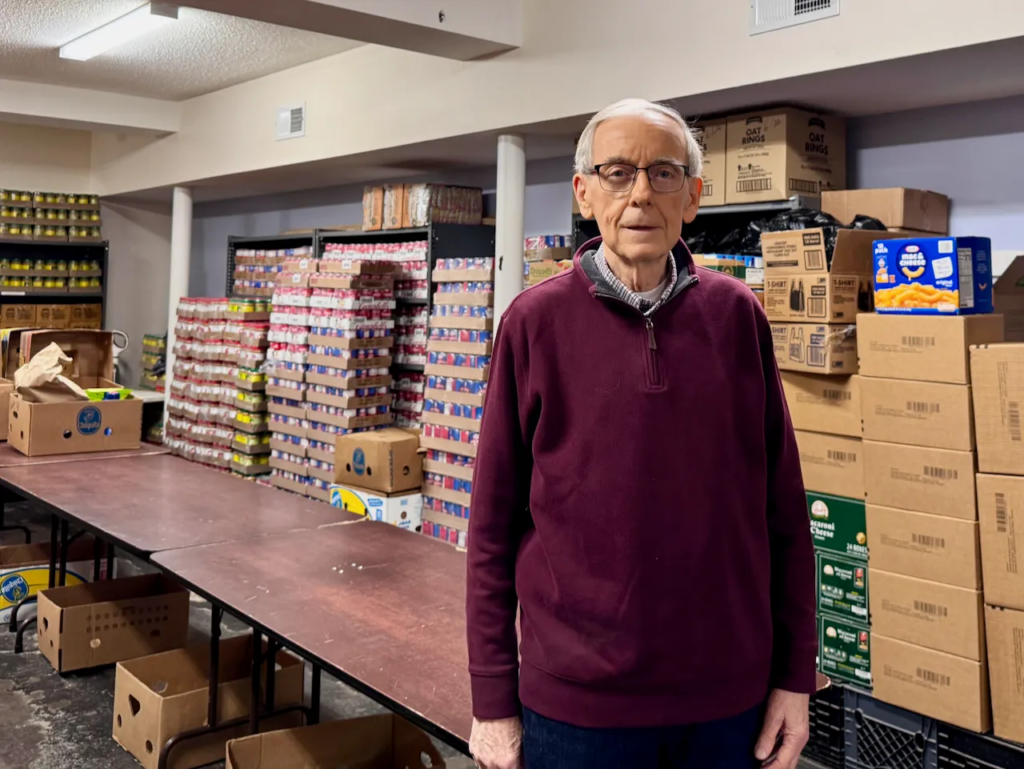
Grace Boucher, Cornerstone’s executive director, said the number of people coming into the community kitchen doubled during the shutdown, going from about 50 people to 100. According to Foodshare, 18% of the people in Vernon were food insecure as of 2025.
Boucher said that thankfully, the shutdown prompted many people to donate food.
“People have really risen to the occasion of knowing that others are in mourning,” Boucher said. “We have people stopping by every day bringing us food and we are very, very grateful for all the community support.”
At the Covenant Food Pantry and Soup Kitchen in Willimantic, local residents came in for food in October as the pause in SNAP benefits was looming.
“We saw people rushing to the food pantries in October because they knew they wouldn’t be able to make ends meet,” Anya Walikonis, manager of community programs and services at the soup kitchen, said. “The tough part was that our shelves were already looking very empty.”
The demand was still high on a Monday in early December when a line of 75 people stretched out the door. Inside, Walikonis and Executive Director Kimberly Clark scrambled to keep shelves stocked and spirits lifted.
“People are having a hard time because we don’t have enough meat, milk and eggs. We don’t have nonperishables,” Clark said. “We went long periods of time without milk and vegetables, and we’re sending people to the store to buy at retail cost because Foodshare didn’t have those things available to us for purchase.”
The shutdown ended on Nov. 12 when President Donald Trump signed a bill that will fund the government until Jan. 30. SNAP and other essential services will be funded until September 2026, NPR reported. However, new work requirements implemented by Congress will see thousands of people in Connecticut at risk of losing their benefits in 2026.
Verrier, the New Haven woman facing food insecurity, said she tends to buy unhealthy food options because they are easier to make. Verrier said she has damaged nerves, muscle pain and heart issues which makes it harder for her to make a nutritious meal.
“I am in constant pain, and standing on my feet is not an option,” Verrier said.
She wishes that more people would understand what it’s like to face hunger.
”It’s like I’m screaming [for] help in the middle of a crowd, and nobody sees me,” Verrier said. “I’m just completely invisible.”
UConn Journalism student Elise Rodriguez contributed to this story. Kitan Arole, Amanda Gonzalez and Alexander Klancko are all UConn Journalism students.