
By Sam Calhoun, UConn Journalism
May 21, 2026
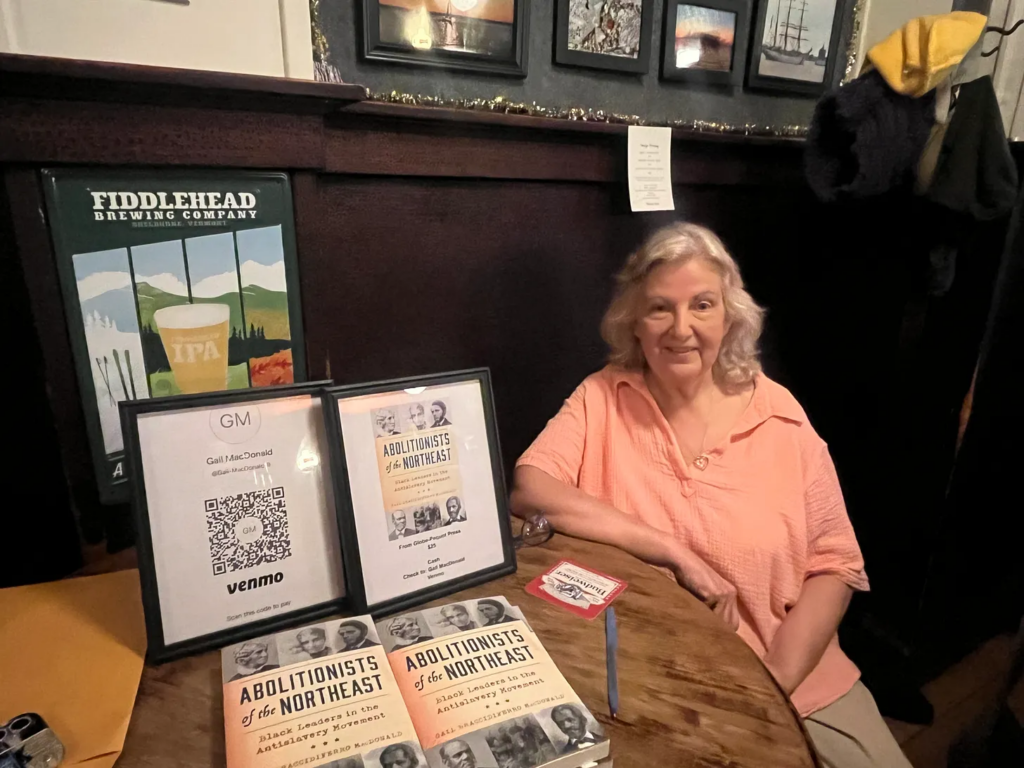
The story of New England’s abolitionists is often told in fragments — names, dates, movements — but rarely in full. That is what Gail Braccidiferro MacDonald set out to change with her new book, which focuses on Black abolitionists.
“I just think these people are so inspiring,” she said. “We don’t really learn about the Black abolitionists, except for Frederick Douglass, perhaps.”
MacDonald, a local historian and retired University of Connecticut journalism professor in residence, released her third book, “Abolitionists of the Northeast: Black Leaders in the Antislavery Movement,” on May 5.
“These are people whose stories haven’t really been told; they’re not as famous, so it’s nice that she’s bringing them to life,” said UConn journalism professor Mike Stanton, MacDonald’s former colleague who has also written books based in New England.
MacDonald said the research for the book uncovered many stories that were new to her.
“I never realized that there were strong Black leaders as early as the late 1700s in this country, because we just don’t learn about them,” MacDonald said.
She used the book to highlight Black abolitionists who faced significant challenges but made significant contributions.
“Andrew Harris, who was the first Black person to graduate from the University of Vermont, spent four years at the University of Vermont basically in total isolation, because no other student would accept him,” MacDonald said.
Another abolitionist who fascinated MacDonald was Charlotte Forten, a young woman who was socially isolated at a school in Salem, Mass.
“She was a teenager just wanting to have fun, and she wrote in her journals about how sad it was that people wouldn’t talk to her; people wouldn’t have anything to do with her,” she said.
Although figures like Frederick Douglass and Harriet Tubman are widely recognized, many Black abolitionists from the same era remain largely unknown.
“It was very heartbreaking to me to know that so many people were shunned and cast aside in this country for so long for no reason except they had a different skin color,” MacDonald said. “They were smart; they were strong. They acted respectfully; they tried to do everything right, and the mainstream society still pushed them aside.”
A Connecticut native, MacDonald attended UConn and then worked as a reporter for The Day. That’s where she met her husband, Bruce, who was also a journalist. The two married in July 1986, and later had a daughter, Cara, who now lives in Middletown.
She worked briefly in public relations and freelance for a variety of publications, including the New York Times, before deciding to get her master’s degree with the intention of teaching at the college level. She earned her master’s in public affairs journalism from American University in Washington, D.C. and taught at several universities before joining UConn’s faculty in 2008. She retired from teaching at the end of 2024.
“The thing that struck me most about Gail was her constant interest in what was going on,” said Timothy Kenny, a former UConn journalism instructor and close friend. “That sort of spark she had for journalism — she passed that on to her students. I sat in on a couple of her classes… You could see it. She really engaged and enjoyed teaching.”
Throughout her journalism career, MacDonald said she was always drawn to writing about history.
“I always found ways that I could do feature stories on history or historic places or events,” MacDonald said. “I just [was] fascinated in making connections between the past and the present.”
MacDonald published her first book “Morton F. Plant and the Connecticut Shoreline: Philanthropy in the Gilded Age” in 2017. Her second book, “Hidden History of Mystic & Stonington,” came out in 2020. Both were published by The History Press.
MacDonald’s husband, Bruce, died in 2022. In the years since, MacDonald has kept herself busy with teaching, finishing her new book and community service. In June, she will be installed as the president of the Rotary Club of New London. She also recently started a new tour business with her friend and former New London events planner Barbara Neff. “Uncovering New London” offers walking and small bus tours that reveal the rich history, fascinating stories, hidden gems and special moments that define the city.
“I can’t imagine any kind of greater purpose than being able to bring that information to the public,” MacDonald said. “That’s kind of what I’ve done my whole life as a journalist —bring important information that people should know about to the public, and hopefully people agree with me when they read the book.”
“Abolitionists of the Northeast: Black Leaders in the Antislavery Movement” was released May 5 by Globe Pequot.