
By Ben Gingold | UConn Journalism
June 15, 2026
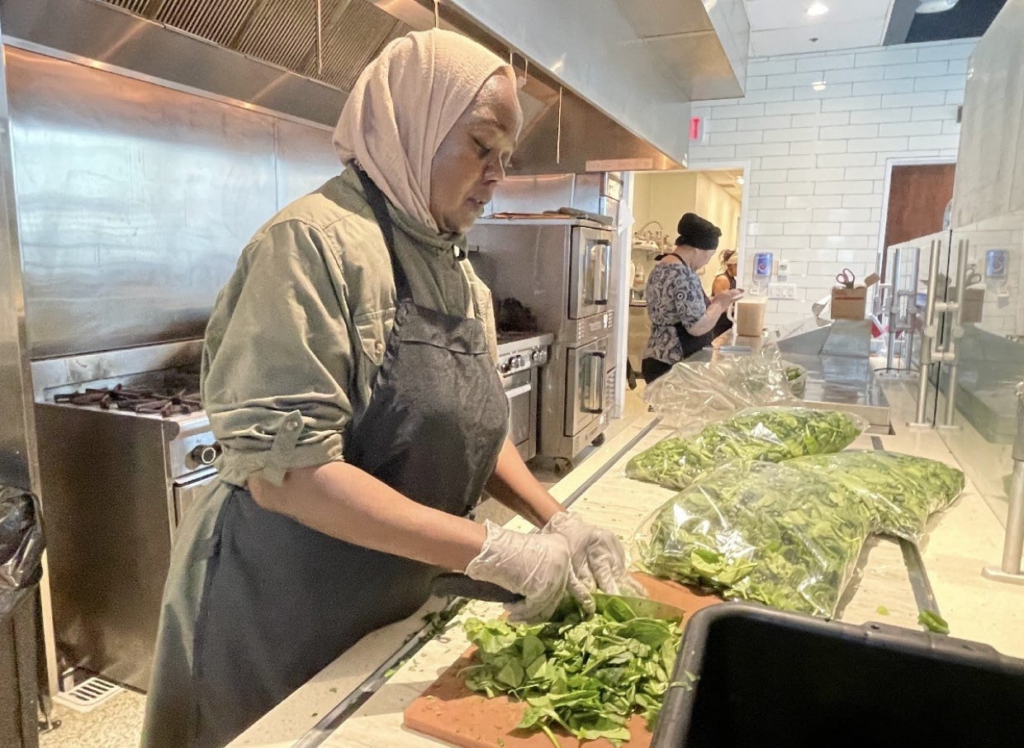
Ragaa Abdalla, surrounded by pots and pans, stuffs a squash with meat and rice. She is making mahshi, a traditional Sudanese dish, in a kitchen nearly 7,000 miles from home.
Abdalla, who now works as a chef at New Haven’s nonprofit Sanctuary Kitchen, fled her home country seven years ago and fears for the safety of her family still in Sudan, including her parents. In recent years, two sparring military factions have fought for control of Sudan, costing thousands of lives in a conflict that has been condemned internationally as a human rights crisis.
“When the war started, that made us grow closer to each other,” said Abdalla about the local Sudanese community in Connecticut. “We are now meeting twice a month, we’re talking about what’s going on in our country, and we try to share some money from each family and send it to our country.”
When Abdalla arrived in Connecticut in 2019, she joined a growing population of Sudanese immigrants taking refuge in New Haven and the surrounding area. In 2024, the World Population Review found that there were 449 Sudanese people living in Connecticut.
“We have a really big Sudanese community from different parts of Sudan, and they live between New Haven and West Haven,” Abdalla said.
At New Haven’s Sanctuary Kitchen, a project of the food-focused CitySeed nonprofit, refugees from many countries around the world are hired to make their culture’s favorite dishes. The goal is to build economic opportunities for disenfranchised people through food.
Each week, they offer a rotating menu of fresh dishes from different cultures, often tailored to the chef’s personal upbringing. Abdalla spends many of her days cooking traditional Sudanese and Egyptian meals. One of her favorite dishes to make is mahshi, or stuffed vegetables. Kofta, a spicy meatball dish which Abdalla noted was the “most delicious food in her country,” came in at a close second.
Civil war
Abdalla grew up in the Nuba Mountains in the south of Sudan, a region she remembers for its lush green hills, culture and brief periods of stability.
In the early 2000s, issues in Sudan came to the forefront of international attention. After a series of humanitarian disasters, Sudan was left especially weak, priming the country for a rebel takeover.
In 2003, after an uprising in the region of Darfur and with ongoing conflict in the south of the country, Omar Al-Bashir, Sudan’s president, began a counterinsurgency operation that would ultimately lead to Sudan’s present civil war. This conflict is between two warring groups, the Sudanese Armed Forces and the Rapid Support Forces. The Rapid Support Forces, or RSF, are a paramilitary group that grew out of the Janjaweed in Darfur, a militia group that Al-Bashir had fostered and armed.
“For years now, millions of Sudanese have been kind of on the precipice of disaster because of the conflict in South Sudan, because of the conflict in Darfur,” said Yonatan Morse, an associate professor of political science at the University of Connecticut.
South Sudan gained its independence in 2011, further weakening Al-Bashir’s government.
In 2018, in the midst of economic crisis, thousands of civilians took to the streets in one of the largest uprisings in Sudan’s history. The following year, amid ongoing unrest, the RSF and SAF joined forces to topple Al-Bashir and violently repress the protests. After international intervention, a civilian government was installed, but it didn’t last long.
In 2022, Prime Minister Abdalla Hamdok resigned and the military was once again in power. Under further international pressure, the RSF and SAF began to grow increasingly hostile toward each other, forming the foundation of the modern humanitarian crisis.
“At some point, the parties agreed to some parameters of a peace deal,” said Morse.
But when a deal was finally brokered, it did not address how to integrate the RSF back into the army. This led to a halt in peace negotiations.
“For the Sudanese army, it’s this idea of monopoly over the legitimate use of force to become a more functional state. For the RSF, the conditions of that were very difficult to swallow,” Morse said.
On April 15, 2023, an arid and windy day, civilians from the hills of Khartoum watched as the RSF and SAF rapidly descended upon each other. The latest civil war had begun and the quality of life for the average Sudanese person plummeted.
Help from the diaspora
Abdalla’s extended family is from Khartoum, which was an epicenter of the rebel uprising.
“I really miss Khartoum, the capital of Sudan,” she said.
Abdalla lost her youngest son three years before the latest outbreak of war, around 2020. As the war raged on, she would ultimately lose her brother as well, in the brutal conflict.
“My little brother, he passed away from the war in Sudan two years ago now,” Abdalla recalled.
Rawaa Ghazi, the director of operations at Sanctuary Kitchen, who also served as Abdalla’s translator, said that she can see the conflict taking a toll on her.
“She always feels sad,” Ghazi said. “She’s always looking for the news, about what’s going on, and always feels that she’s not able to do anything to help her family.”
Sudan is now at the center of one of the biggest refugee crises in modern history, with more than 13 million Sudanese estimated to have been displaced since the conflict began, according to the United Nations Refugee Agency.
In New Haven, Abdalla and other Sudanese refugees are doing what they can to help their people. To ease the financial strain on relatives abroad, they have organized a mutual aid group that meets twice each month.
“All of them don’t have a lot of money, but they try to collect maybe $20 from each family, and they send it to the people there who live in the mountains,” Ghazi said.
At the end of each meeting, they collect money from the families and pool it together.
“They are really suffering,” Ghazi said, “so when this small money arrives there, it makes a big difference.”
Even though these families were brought together by war, the bi-monthly meetings have served as a unique bonding opportunity for New Haven’s Sudanese community.
Abdalla said she doesn’t see an end to this war. She has watched government after government fail to usher in systematic change, but she still has faith in the Sudanese people.
“We are known for our kindness. We are very kind people. These are the qualities that Sudanese people will always have,” Abdalla said.
She looks forward to the day when she can finally visit her family again. “After the war stops, I think this is the most important thing,” she said.
“When the war stops, and then the people are having a chance and opportunity for work, they can support their family and build factories, build schools, and hospitals,” Abdalla said. “That all will make Sudan a good country for the people to live in.”