By Mikayla Bunnell
UConn Journalism
Read more to learn about expansions of executive power under presidents Franklin D. Roosevelt, Lyndon B. Johnson and Ronald Reagan.
Franklin D. Roosevelt (1933–1945)
Expansions under the New Deal and a proposed way to reshape the Supreme Court
Franklin D. Roosevelt expanded the presidency to more than just chief executive, the Miller Center said — he made the president a chief legislator, a “drafter of policy.” Roosevelt’s New Deal legislation moved the country away from dual federalism, in which states and the federal government are two distinct entities each with their own powers, to cooperative federalism, where state and federal government overlap more in terms of powers.
In his first inaugural address on March 9, 1933, Roosevelt made clear that he was ready to do what it took to bring the nation out of the Great Depression. He said that he was ready to make unprecedented moves to combat the unprecedented difficulties the country was facing.
“It is to be hoped that the normal balance of executive and legislative authority may be wholly adequate to meet the unprecedented task before us,” he said. “But it may be that an unprecedented demand and need for undelayed action may call for temporary departure from that normal balance of public procedure.”
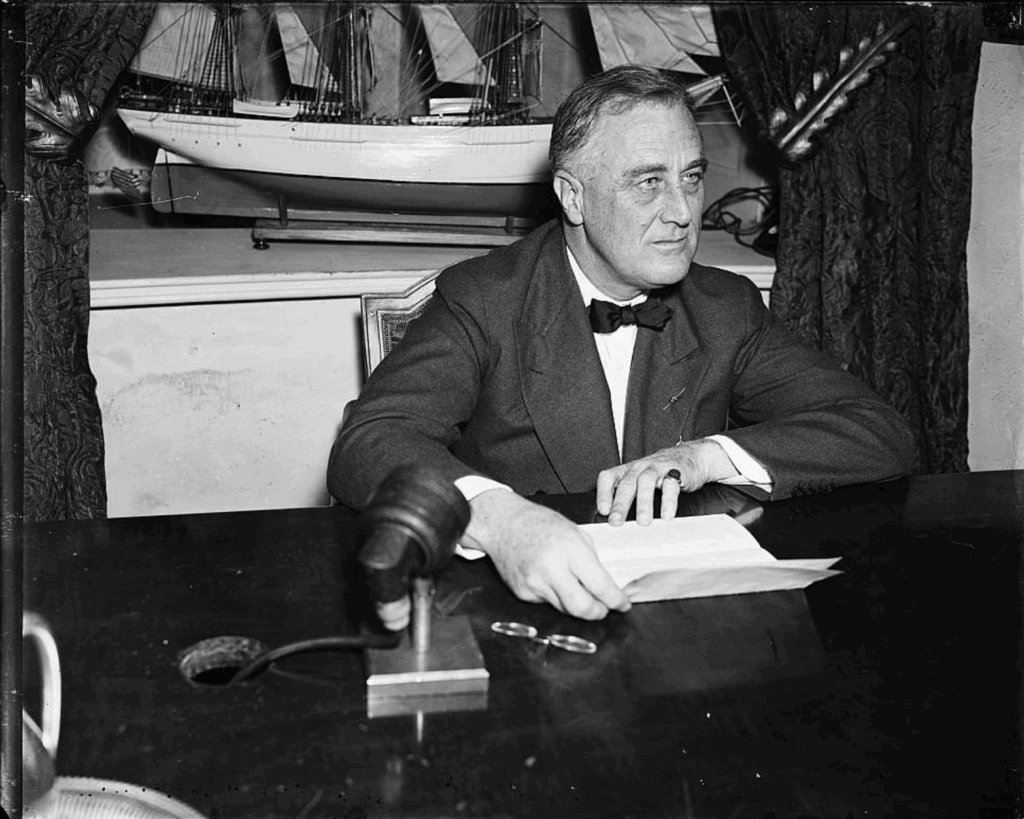
Roosevelt asked that Congress give him “broad executive power to wage a war against the emergency” if they couldn’t pass his recommended measures of their own to end the Depression. Congress ended up doing just this, as much of the New Deal consisted of Congress delegating powers to the executive branch to regulate the economy.
“The New Deal produced a presidency that was more institutionally independent of Congress and more politically free of the parties than ever before,” wrote John Yoo, a law professor at the University of California Berkeley. Roosevelt led Congress to create a “vast administrative state.”
For much of the New Deal legislation passed, the executive branch drafted the legislation and sent it to Congress, which approved it after glancing at it — or not looking at all, Yoo said.
One of these bills was the National Industrial Recovery Act and the subsequent National Recovery Administration, which put in place by executive order after the original act was passed. The act suspended antitrust laws and required companies to “to write industry-wide ‘codes of fair competition’ that effectively fixed prices and wages, established production quotas, and imposed restrictions on entry of other companies into the alliances,” according to the National Archives.
The National Recovery Administration made agreements with industries about work hours, pay rates and price-fixing, creating more than 500 codes of fair practice for many industries. The act and the agency did not last long, however. In A.L.A. Schechter Poultry Corp. v. U.S. (1935), the Supreme Court struck them down, saying that the president cannot have unchecked power to do whatever he thinks is necessary to achieve a goal.
This opinion became a driving force behind Roosevelt’s court-packing plan. Much of the New Deal legislation was found unconstitutional, mostly on the grounds of violating the separation of powers between the executive and legislative branches. According to the Supreme Court Historical Society, “no Supreme Court had ever struck down so many laws so quickly.”
In 1936, after winning reelection for his second term in a landslide, Roosevelt proposed increasing the Supreme Court from nine justices to 15. This plan would have allowed Roosevelt to appoint six new justices that would, ideally, vote in his favor, though Roosevelt suggested the additional justices would only serve to lighten the court’s caseload. The pressure campaign is credited with pushing the Court to change their harsh outlook on New Deal legislation, though the plan failed to pass in Congress. For example, the Court upheld the Social Security Act in 1937 and upheld state minimum wage laws after previously ruling against them.
Roosevelt also expanded the president’s social reach through his Fireside Chats, which “connected the White House to ordinary American homes as never before,” according to the White House Historical Society. At the peak of the New Deal era, Roosevelt would hold these chats on the radio twice a year. During these chats, Roosevelt would campaign for and defend his policies directly to Americans. Yoo said this helped make the president a “driving force for positive government,” rather than just a political leader.
Lyndon B. Johnson (1963–1969)
Expansion through the Great Society and the Vietnam War
Lyndon B. Johnson became president after the assassination of John F. Kennedy in 1963. His presidency saw a “vast expansion in the role of the national government in domestic affairs” according to the University of Virginia’s Miller Center.
Johnson’s Great Society policy initiatives resulted in legislation like the Civil Rights Act and the Voting Rights Act. They required the national government to become more present in the states, from providing “federal registrars and marshals to enroll African American voters” to implementing federal government-run community action agencies in municipalities to help the poor, a Miller Center article said.
Much of Johnson’s Great Society work came through executive orders. As president, Johnson passed 57 executive orders, side-stepping Congress through extra-legislative policymaking. A lot of his orders had to do with civil rights and affirmative action.
In early August 1964, Johnson announced that the North Vietnamese had attacked U.S. navy ships. Days later, Congress passed a resolution giving the president, in his powers as commander-in-chief, the power “to take all necessary measures to repel any armed attack against the forces of the United States and to prevent further aggression,” giving the president great authority to deploy the armed forces.
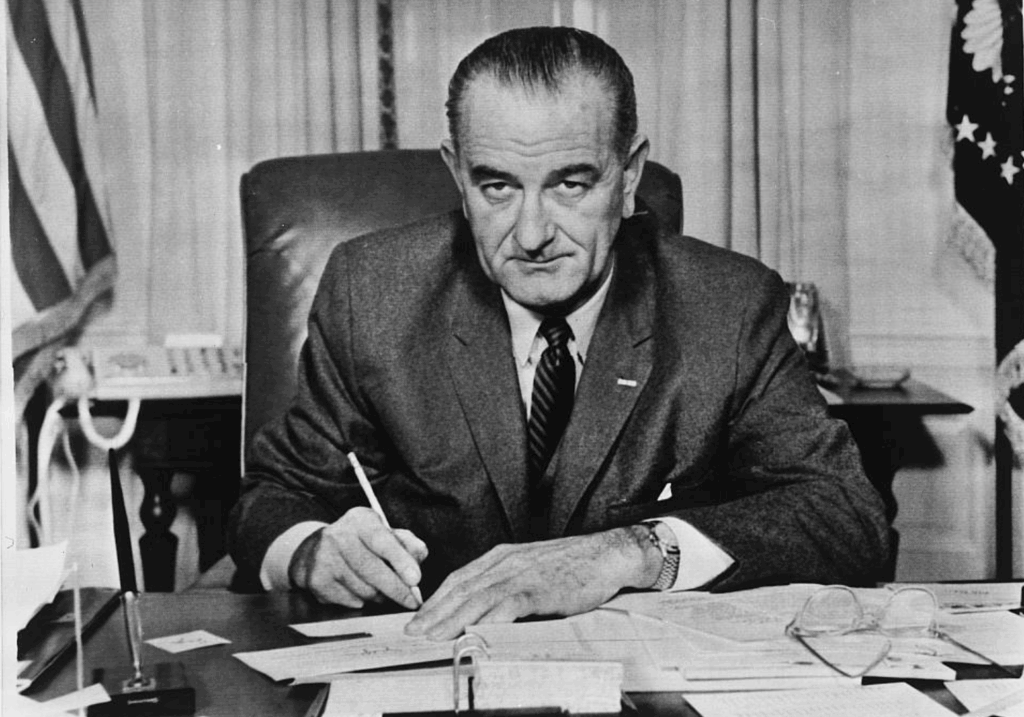
This led to the U.S. getting involved in the Vietnam War without a formal declaration of war from Congress. It allowed Johnson to do whatever he saw necessary to respond to attacks against the U.S.
Though it is one of their constitutional powers under Article One, Section Eight, Congress has not formally declared war since World War II.
The resolution was repealed in 1971 as the war’s unpopularity grew, according to the Constitution Center.
Ronald Reagan (1981–1989)
Introducing the unitary executive theory
Ronald Reagan’s administration is often described as the first to use the unitary executive theory to expand power. Just one month after his first inauguration, Reagan signed an executive order allowing the president to have oversight over regulatory actions of federal agencies. Before implementing any actions, the order said, agencies must submit a “Regulatory Impact Analysis” to the Director of the Office of Management and Budget, who is appointed by the president, to prove that the regulations would benefit society.
David Schoenbrod, a trustee law professor emeritus at New York Law School, said that Reagan was a selective proponent of the separation of powers, but only when it favored the executive branch.
Reagan fought against the legislative veto, which allowed congressional resolutions (which don’t have to be signed by the president) to overturn executive agency actions, though he did not fight against statutes that delegated legislative power to the executive, such as the Sentencing Reform Act of 1984 that gave a presidentially appointed commission power to establish criminal sentencing rules.
You must be logged in to post a comment.