By Breanna Bonner
UConn Journalism
Afra Hassan-Pour, an international student pursuing her master’s degree at the University of Connecticut’s School of Fine Arts, said she chose to study in the United States after learning it is one of the best places in the world to study art management.
Now Hassan-Pour said the climate in the U.S. feels increasingly hostile toward people from other countries.
“It feels like the goal is to make things hard for every international person in the U.S. and make them leave the country,” she said. “And a big part of it is this hysteria, this mental scare, this fear that is being created every day through news, through media, through propaganda.”
In the first year of President Donald Trump’s second term, international students have experienced increased political, legal and ideological hostility amid intense crackdowns on immigration and scrutiny of international visitors and students. More than 6,000 international student visas were revoked from the start of Trump’s term through August, according to U.S. Secretary of State Marco Rubio. Of those, 40 were for students in Connecticut, including 13 at UConn, which were later restored.
Nationwide, the number of new international students enrolled in U.S. institutions in fall 2025 decreased by 17%, according to the Open Doors 2025 data report. UConn’s international enrollment is down almost 8% from 3,455 in fall 2024 to 3,189 in fall 2025.
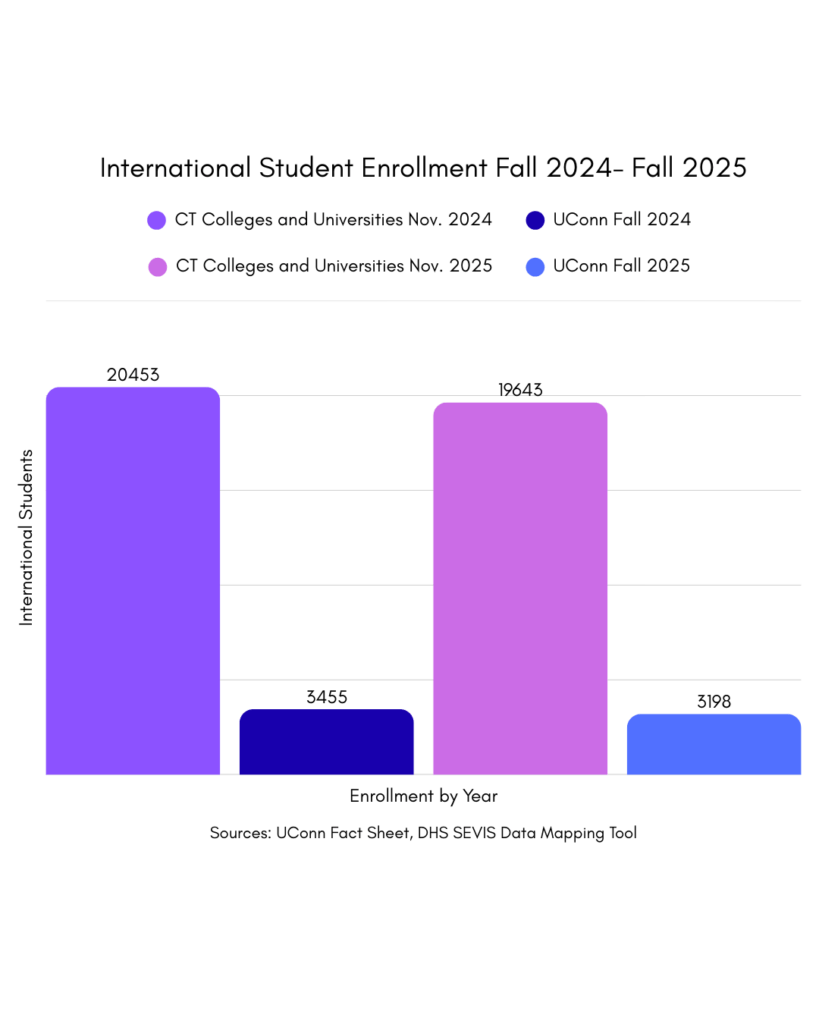
International students “feel less free and less welcomed,” said Arthur Galinat, director of UConn’s Center for International Student Services and Scholars. “We’ve seen an attack on universities and international students that we’ve never seen before”
The U.S. hosts the greatest number of international students globally, with an entering class of around 1.1 million international students in 2024, which was about 6% of total enrollment at U.S. institutions, according to Inside Higher ED.
Most international students attend university through an F‑1 visa, which allows them to study at an accredited college or university. Student and Exchange Visitor Information System visa terminations have led to international students having their visa status suddenly revoked, being removed from their jobs and becoming subjected to deportation. In March, over 1,500 students reported a sudden change in their information system listing or visa status across 250 universities, according to Inside Higher ED.
In response to backlash against student visa revocations, Rubio said the actions were justified. “Let’s remember again – student visas, OK, are not a right. There is no constitutional right to a student visa. A student visa is something we decide to give you,” he said. “So, if I would have denied you a visa had I known something about you…why wouldn’t I be able to revoke your visa?”
In April, the American Civil Liberties Union sued the Department of Homeland Security for the sudden termination of four international students’ visas who were studying in Connecticut: Yan Du and Mengni He from Yale University, as well as Elika Shams and Stephen Azu from UConn.
According to the U.S. District Court complaint filed by the ACLU, the plaintiffs became afraid to go to “lab, class, or even the grocery store” for fear of sudden deportation. The court ruled in the student’s favor, ordering the restoration of their visas and preventing further action on their status by the federal government. While their status was restored in late May, ACLU Connecticut legal director Dan Barrett said it had lasting impact on international students.
“I think it’s quite fair for those students to really wonder whether the other shoe is going to drop,” Barrett said.
Barrett also noted that international students are self-censoring in response to increased scrutiny from the federal government.
“They’re censoring themselves,” Barrett said. “The government has, at the moment, made it really clear that they think that there’s some kind of loophole that allows them to punish people in the United States for expressing views, even if they express those views… before coming to the United States. So yeah, I think they’re keeping their heads down.”
Recently there have been high-profile cases of international student visas being revoked due to their participation in protests, including included Mahmoud Khalil, a Palestinian student at Columbia University who was arrested in March by ICE for his involvement in a pro-Palestinian protest. Rümeysa Öztürk, a PhD student at Tufts University, was detained by ICE in March after co-writing a pro-Palestinian op-ed for the college newspaper, according to the ACLU.
International students have had to wait longer to enter the country due to enhanced vetting and the extra time needed to review applications. Recently, this process has included social media vetting of all F, M and J visa applications, according to a media note from the U.S. Department of State.
Trump has also urged schools to limit international students. In a compact letter to nine universities in October 2025, Trump asked schools to limit international student enrollment to no more than 15% of undergraduate students to receive priority for federal funding. International students currently make up 9.4% of UConn’s student body, excluding UConn health and law campuses, according to UConn spokesperson Stephanie Reitz.
Hwong Pham, international student adviser for UConn’s Center for International Students and Scholars, said she believes that the changes and uncertainty will lead to a nationwide decline in international student enrollment.
“The environment that is going on right now… everything is so hard. The application is so hard. The visa is hard, and [international students] might not even get it. We are making it more difficult for them to really even want to be here,” Pham said.
UConn’s status as a top 25 university draws in students from around the world. However, Thomas Katsouleas, an engineering professor who previously served as UConn president, said the national climate has shifted.
“They just feel a general sense of being less welcome, and they also have clearly lost the ability to have the free speech that we as citizens have,” he said.
Katsouleas said he believes that the presence of international students is integral to the learning environment at UConn and other institutions.
“The argument has always been…that the student learning experience was enhanced by having a diverse cohort of peers, and there’s research to support that,” he said.
International students contribute to U.S. innovation, often staying in the country after graduation on an H1B visa to work in specialized fields. International students contribute over $44 billion to the economy annually, according to the Council on Foreign Relations.
Some students say the policies have led to daily anxiety and hypervigilance. Chizobam Nweke, a doctoral student from Nigeria, said he now always carries two copies of his immigration documents, “just in case.”
Though it sometimes feels extreme, Hassan-Pour and her partner do the same.
“Based on the current situation, we need to be ready to show documents to whoever is trying to persecute us or whatever happens — especially like seeing all the videos on social media and on the news and how immigrant people are treated,” Hassan-Pour said.
As policy continues changing and uncertainty lingers, Hassan-Pour has a request for the broader community looking to support international students.
“What I want them to know is how important it is to be accessible to people who are living in this kind of situation,” Hassan-Pour said. “If they text you and they want to talk to you, please make time for them.”
Anna Heqimi contributed reporting to this article.
You must be logged in to post a comment.