By Christi Thrower
UConn Journalism
Underrepresented. Diversity. LGBTQ. Woman.
These are some of the words or phrases deleted from federal agencies’ websites and targeted by grant cuts in the past year – just one part of a sweeping campaign by President Donald Trump’s administration to remove “DEI rhetoric” from public life.
In the first year of his second term, Trump has used threats to federal funding, executive orders and the vast power and influence of the federal government to try to dismantle diversity, equity and inclusion programs that he claims are discriminatory and illegal. The impact has been felt nationwide, with some corporations and school systems renaming DEI policies and initiatives or abolishing them altogether.
Experts who oppose this culture shift around DEI say it is censorship, erasure and an inefficient use of government time that could further harm already disadvantaged people in higher education, public schools, the workforce and the federal government.
“I think it’s just a way to erase certain people’s existence,” said Micah Heumann, director of UConn’s Office of Undergraduate Research who has researched racism in higher education.
Heumann said the attacks on DEI programs and research is a loss for human rights.
“I really think you can judge a society by how they treat the most vulnerable… and that’s [what] we’re talking about with diversity, equity, inclusion,” Heumann said. “It’s not just race or gender. When we’re talking about DEI, we’re talking about first-gen students. We’re talking about vets… We’re talking about getting accessibility.”
The legality of DEI
According to Diversity, Equity & Inclusion Inc., a nonprofit organization dedicated to DEI education and resources, the phrase entails frameworks of how organizations should enable access for marginalized groups. These frameworks are intended to move organizations beyond surface-level representation and toward proper integration of diverse groups to benefit everyone, the organization explains.
However, Trump has insisted that DEI has kept organizations from hiring based on merit. In an executive order to “end illegal DEI,” Trump calls DEI “radical” and “dangerous” and claims that DEI has reversed “the progress made in the decades since the Civil Rights Act of 1964 toward a colorblind and competence-based workplace.”
“DEI’s foundational rhetoric and ideas foster intergroup hostility and authoritarianism,” the order said.
The claim that DEI is illegal is unsubstantiated in the order or by the White House, as is the assertion that “DEI hiring” is not based on merit. Some legal experts say these orders violate the law.
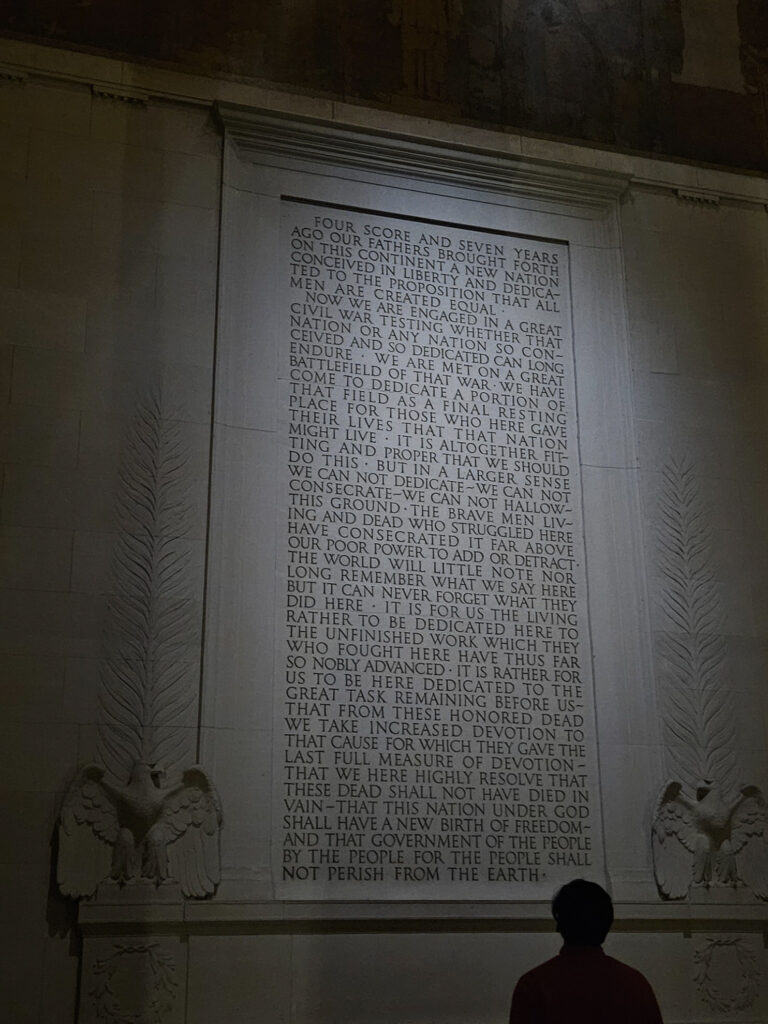
Photo by Mikayla Bunnell
According to Dan Barrett, legal director of the American Civil Liberties Union (ACLU) of Connecticut, Trump’s executive order that threatens federal funding for schools with DEI policies violates the First, Fifth, and 14th Amendments of the Constitution.
“You can’t just tell schools there’s a vague list of topics that I won’t let you teach, and if you do, I’m going to immediately pull all your funding,” Barrett said.
Connecticut Attorney General William Tong said he also believes that the federal government leveraging power over the states with DEI attacks is a breach of sovereignty for the states.
“You do your job. We’ll do our job,” Tong said. “You can’t commandeer state and local resources.”
Trump’s targeting of DEI
DEI has become a favorite scapegoat of the Trump administration.
In January 2025, after the collision of an American Airlines plane and a U.S. Army helicopter, Trump blamed the crash on DEI in a speech while the investigation was still ongoing, according to the Associated Press. He said he wanted “somebody that’s psychologically superior” to the alleged diversity hires to work in air traffic control.
When asked how he knew diversity was responsible for the crash, Trump said, “because I have common sense. OK? And unfortunately, a lot of people don’t. We want brilliant people doing this.”
Trump has a history of questionable racial comments like these before entering politics and in his first term. He has consistently cited disinformation or made disparaging remarks targeted toward predominantly black communities and countries, lied about Barack Obama’s ethnic origins and religion, allowed and avowed support from white nationalist groups and shown preferential treatment of white people in his business practices, the New York Times reported.
Trump has also sought to remove references to diverse populations, especially transgender and non-binary people, from federal government websites, agencies and archives, according to NPR. This included directing federal government websites to be stripped of references to historic firsts by women, non-white people and LGBTQ+ people. For example, paragraphs honoring the Tuskegee Airmen in WWII and the Women Airforce Service Pilots were removed from the Air Force’s website, according to Time Magazine.
“The Tuskegee Airmen bravely fought and died for our freedoms before this nation even granted them the full benefits of citizenship,” U.S. Rep. Terri Sewell, a Democrat from Alabama, said following the removal. “To strip them from the Air Force curriculum is an outrageous betrayal of our values as Americans. Their heroism is not DEI.”
DEI’s promoting of various groups of color and gender brings attention to racism and systemic injustice, so it has become the latest acceptable target, Heumann said.
“History repeats itself. We know that,” said Heumann, the father of a transgender son and relative of Holocaust survivors. “You can’t ignore stuff that’s happening, even if it’s not happening directly to you, because it’s happening to another fellow human being.”
The benefits of DEI
Proponents of DEI point to statistical benefits of diversity in organizations. According to management consulting firm McKinsey & Co., which does extensive economic research, a greater diversity of people with different backgrounds can provide a variety of perspectives to the group as a whole and boost efficiency. “The likelihood of diverse companies outperforming industry peers on profitability has increased significantly,” the company said in a 2020 report.
Some studies have also found that DEI policies are popular among the public. A CNBC survey from 2021 found that nearly 80% of workers want to work in a place that values DEI.
Heumann said he believes that DEI is “necessary to create equity in our society.” Lingering disparities from segregation and discrimination still exist and need to be addressed, he said. While DEI initiatives don’t provide all the solutions, “I think these are ways to help offset/balance history… get us back to where we need to be,” he said.
According to the U.S. Census Bureau, Black and Hispanic household income, for example, remains significantly lower than white household income nearly across the board. Similarly, queer people are more likely to face discrimination in employment and housing, according to studies by the University of California, Los Angeles and the University of Chicago. The Trevor Project, an international suicide prevention nonprofit organization for LGBTQ+ youth, said LGBTQ+ youth also face higher rates of homelessness and mental health struggles.

Jeffrey Hines, vice president for the Office for Inclusion and Civil Rights at the University of Connecticut and UConn Health, said he believes DEI is best if it is “ubiquitous,” or throughout all facets of society.
“Diversity is broadly defined. There’s diversity of representation, diversity of perspective, and diversity of where you live,” he said. “That diversity actually improves for all, so it’s not a benefit that singularly benefits and affects one group of people.”
The culture shift surrounding DEI in federal government
In addition to Trump’s purging of alleged DEI terminology and history from federal websites, Trump has directed all federal DEI programs to be shut down, according to Time magazine. DEI staff were also placed on paid leave and eventually terminated. Trump’s order and the memo from the Office of Personnel Management did not define what “DEI offices” were, but said that DEI offices may try to “disguise” their true intentions behind obscuring language and encouraged employees to report them.
The federal government is the nation’s largest employer. Some federal employees who are minorities told NBC that they were afraid of the DEI culture shift, and some LGBTQ+ workers said they would go back in the closet.
The U.S. State Department said in November 2025 that it would be implementing new requirements for what is defined as a human rights violation in diplomatic relations. It included DEI policies as well as abortion and facilitation of mass migration.
“In recent years, new destructive ideologies have given safe harbor to human rights violations,” State Department deputy spokesperson Tommy Pigott said in a statement, according to CNN. “The Trump administration will not allow these human rights violations, such as the mutilation of children, laws that infringe on free speech, and racially discriminatory employment practices, to go unchecked.”
The culture shift surrounding DEI in companies
The Trump administration has also targeted DEI outside of the federal government, having a major impact on culture more broadly.
Organizations that rely on federal funding, such as arts organizations that receive grants from the National Endowment for the Arts, have seen funding cuts that some suspect are related to new anti-DEI federal guidelines, according to NPR. Connecticut theaters have been among those nationwide that were left scrambling to make up costs for productions years in the making.
Along with the pressure and rhetoric from the White House, there has been a cultural shift around DEI, with several private companies announcing that they have rolled back DEI programs in their organizations, according to AP News. Major companies included Google, Amazon, McDonald’s, and Meta — the parent company of Facebook, Instagram and Threads.
Google rescinded a goal to increase representation of minorities among the company’s leadership team by 30%, according to AP News. Meanwhile, Meta and Amazon are among those companies who have ended DEI programs, with Amazon referring to DEI programs as “outdated.”
Companies have shaped their policies and public statements around Trump’s rhetoric. Some companies stated in press releases that they had not engaged in practices like “hiring quotas,” which are one of the things Trump’s references when he claims DEI is discrimination. Walmart said it would end priority treatment for diverse suppliers, make sure family tents at pride events are separated from drag shows and monitor third-party items to make sure they do not include products for transgender youth, such as chest binders. Disney didn’t mention the word “diversity” in its annual report for the first time in several years, Business Insider reported.
A study by Gravity Research found that companies quickly abandoned DEI language once Trump took over. The May 2025 study found a 98% decrease in the mention of the word “DEI” among 1,378 public documents from Fortune 100 companies. There was also a 72% decrease in general DEI language and significantly less mention of workforce demographics.
The culture shift surrounding DEI in education
The Trump administration has also gone after DEI in K‑12 schools by threatening funding for schools with DEI programs or that use “gender ideology” in sex education curriculum. Activist Zinnia Jones, a transgender woman who writes a blog called “Gender Ideology,” said the phrase has a history of dehumanization against trans people because it asserts that being trans is an ideology rather than an identity.
Hines said attacks on DEI in schools as well as the Trump administration’s decimation of the federal Department of Education disproportionately impact already disadvantaged communities.
It “will affect communities historically marginalized. So, as you dismantle Title I, many of those under-resourced schools are communities of color. That’s a direct effect of the DOE being dismantled,” Hines said.
Universities have also been targeted for DEI programs and other initiatives.

In a memo issued on July 29, 2025, the federal education department advised schools and universities that DEI programs were “discriminatory” and unlawful and would lose federal funding. On November 3, 2025, UConn’s Senate voted to delay a requirement for undergraduates to take an anti-black racism course that was in development since 2023, citing Trump’s orders as one of the reasons for doing so. Instead, they will establish a task force to reevaluate the ABR course and likely won’t offer the course until 2027.
UConn’s Undergraduate Student Government President Andy Zhang voted in favor of the task force and believed mandating the course would bring “unwanted attention” to UConn. “We don’t want to get rid of [the anti-black racism course requirement], but we want to do it in a way that is feasible and successful and works for everyone,” Zhang said.
UConn has also renamed its Office of Diversity and Inclusion and merged it with other UConn departments; Hines said this is not a result of the current administration, however.
“UConn firmly stands by the core that DEI is foundational for our mission,” he said.
Madeline Perez De Jesus, director of Campus Climate at Connecticut State Community College, said the college will also be reframing and renaming diversity departments and that it is doing so in recognition of a cultural shift in public thinking about DEI. She said the renaming is not being done to “hide discrimination” as the Trump administration has accused agencies of doing, but to continue serving everyone in the best manner they can.
DEI “means that because there’s been a history of exclusion, part of undoing and part of being truly equitable is to kind of highlight those groups only because they’ve had a history in this country where they have been intentionally excluded,” Perez De Jesus said. “I think now we’re using different language to highlight serving everyone.”
University research has also been targeted. Former UConn President Thomas Katsouleas said the administration is combing through titles and descriptions searching for keywords that indicate the research might relate to DEI or focus on a particular minority group.
“The content-specific attack is a wholesale cancellation of research grants and contracts that have anything to do with ideologies that the administration doesn’t support,” Katsouleas said.
Heumann said this is governmental overreach that promotes a culture of fear in academia as well as anti-intellectualism. Plus, attempts to comply with the Trump administration’s edicts are making things much less efficient.
“The amount of work we’ve had to do at higher education institutions to redo grants, redo things… that’s about as wasteful of time as you can get,” Heumann said.
You must be logged in to post a comment.