By Elijah Polance
UConn Journalism
In the year since President Donald Trump took office, he has signed five executive orders directed toward the transgender community.
Framed as protections for women and children, the orders target recognition and inclusion of transgender individuals in federally funded programs and schools. The first order said the federal government will only recognize “male” and “female” as acceptable genders, based on one’s sex assigned at birth – affecting a variety of things from prison and immigration detention to U.S. passports. A pair of orders targeted what the Trump administration called “gender ideology” in public schools and other organizations. Another threatened to withhold funding from medical providers who offer gender-affirming care for transgender youth. Two other orders prohibited transgender people from serving in the military and transgender women from competing in women’s sports.
Dan Barrett, legal director of the American Civil Liberties Union of Connecticut, described the Trump administration’s actions as an attempt to erase transgender people.
“As a matter of law, the national government right now seems to want to make it so that there’s no such thing as being transgender, and that is playing out in a variety of ways,” Barrett said.
Along with the executive orders specifically directed at the transgender community, other orders repeal diversity, equity and inclusion initiatives and anti-discrimination protections for LGBTQ+ individuals. Many of Trump’s orders are facing lawsuits from states and advocacy groups, and some have been blocked by federal courts. Still, transgender people and allies in Connecticut say the orders have made the lives of transgender people more difficult and makes it feel as if their own government is against their existence.
Excluding transgender people from the military
The government’s policing of LGBTQ+ individuals is not new. Micki McElya, a history professor at the University of Connecticut, said that stricter federal regulation barring LGBTQ+ people from the military has coincided with the increasing recognition of LGBTQ+ identities.
During World War I, the U.S. Navy investigated and purged sailors having gay sex, she said. By World War II, homosexuality was considered a mental illness that could bar citizens from serving in the military. This coincided with the “Lavender Scare,” a period from the late 1940s to 1960s when federal employees outed as gay were fired from the federal government.
While the officiated discrimination ended in the federal government in 1975, it continued in the military. Continued scrutiny from activists, led to the “Don’t Ask, Don’t Tell” policy in the 1990s under President Bill Clinton. The policy prohibited openly gay, lesbian and bisexual people from serving in the military. However, if military personnel did not disclose this information, they could continue to serve.
McElya described this as an oppressive framework that barred representation of LGBTQ+ identities.
“There’s a suggestion that were one not to be visible, were one to stay in hiding, they could continue to serve in the military,” McElya said. “This is something that activists across time, both in and outside of the military, have really called the contradiction. If you don’t know I’m queer and I’m a good soldier, or I’m a good sailor, that doesn’t change when you know my identity, right?”
President Barack Obama repealed “Don’t Ask, Don’t Tell” in 2011, and starting in 2016, transgender people were allowed in the military.
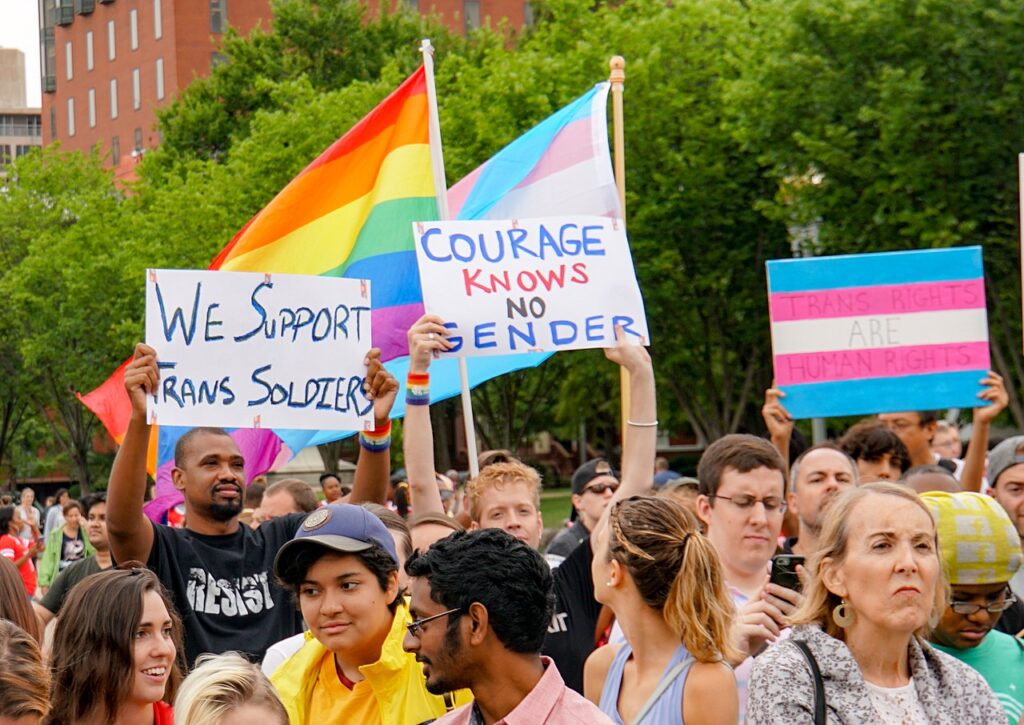

After Trump took office the next year for his first term, he tried to prohibit this with an executive order. Federal courts blocked it, forcing the administration to enact a more specific policy that still allowed some transgender people to serve.
Seven days after taking office for his second term, Trump signed the executive order “Prioritizing Military Excellence and Readiness,” again banning all transgender people from serving in the military. While the order was initially blocked by an injunction from a federal district court, the U.S. Supreme Court in early May allowed the ban to go into effect as legal challenges against it advanced through the courts, according to the Associated Press.
“We’re seeing what we saw historically again, right now with transgender service personnel,” McElya said.
The executive order said that being transgender goes against the lifestyle required of a service member. Part of the order said: “A man’s assertion that he is a woman, and his requirement that others honor this falsehood, is not consistent with the humility and selflessness required of a service member.”
In mid-November 2025, 17 transgender veterans of the U.S. Air Force and U.S. Space Force, all of whom had served for at least 15 years and were forced to stop serving because of Trump’s executive order, sued the military for denying them promised retirement benefits. According to the legal complaint, each member applied and got approved for Temporary Early Retirement Authority, but in August 2025, the U.S. Air Force rescinded their benefits.
“It feels like a betrayal,” Master Sgt. Logan Ireland, one of the impacted veterans, said in an interview with NBC news. “I’m just another service member serving his country, and for me, I want my leadership to see that, to see my service as honorable.”
Restricting passport genders and self-identification
The Trump administration has also targeted transgender citizens more broadly in ways that complicate self-identification and travel. One of the first executive orders Trump signed mandated that passports, visas and global entry cards would reflect the gender of one’s assigned sex at birth and only recognize people as “male” or “female.” An ACLU lawsuit in a federal court in Massachusetts led to a temporary injunction on the order in June 2025. But in November, the Supreme Court allowed the passport restriction to go into effect as the lawsuit continues.
These new regulations may be incongruous with state policies about identification documents. In Connecticut, residents are allowed to change their gender markers on state identification documents, including drivers licenses and birth certificates. Connecticut also allows “X” as a gender marker for those who do not identify as male or female. Barrett of the ACLU said this could set up a confusing conflict between state and federal records.
“For purposes of your Connecticut driver’s license, you’re a man, you’re a male gender, but for purposes of a passport, the national government considers you to be a woman,” Barrett said. “So you may have this complete divorce of how the two governments view you.”

Rae Horsestreingth and Agatha Larch, a couple from Litchfield County who are both transgender, said they immediately took steps to change their names and gender markers on their passports upon Trump’s re-election in November 2024. Their passports did not get processed, though, until after Trump’s inauguration and the executive order, so their gender markers did not get changed in time.
When the executive order was put on hold by the courts in June 2025, Horsestreingth was able to get the gender marker on his passport changed to male. But Larch, who was also applying for dual citizenship with the United Kingdom, had a more involved process and longer wait times. A transgender woman, she was unable to change her gender marker on her passport to female before the new rules went into effect.
“Trying to have my license and my U.S. passport and my U.S. birth certificate match the documents that I’m trying to work out with my English stuff is weird,” Larch said. “I have no idea how that’s going to work because both of these countries have totally different approaches to people like me. The rules are different on each side, but they’re kind of supposed to match. And the problems that can arise… I don’t even know what I’m going to run into, which is weird. That doesn’t feel like how that should be.”
Preventing preferred self-identification on passports can lead to difficulty for transgender people trying to work in the U.S. or travel abroad.
“It’s about social smoothness, being able to navigate things truthfully and not having paperwork mix ups that are annoying for employers and the employee,” Horsestreingth said.
Suppression of gender-affirming care
The Trump administration has also attempted to forbid gender-affirming care for people under 19 years old through the executive order, “Protecting Children from Chemical and Surgical Mutilation.” The order threatens to withhold federal funds to medical facilities and professionals who provide hormone therapy or surgical treatment for minors experiencing gender dysphoria to transition to the gender that fits their gender identity. Trump, in a 2023 video posted to his Truth Social page, described gender-affirming care for minors as “child abuse” and “child sexual mutilation.” The order also calls for the federal government to stop recognizing what it calls “junk science,” specifically research from the World Professional Association for Transgender Health on gender-affirming care.
A federal judge issued an injunction in early March 2025 that put the executive order on hold after a lawsuit by PFLAG, an LGBTQ+ advocacy group. Still, hospitals across the country and in Connecticut have changed their policies to comply. In July, Yale New Haven Hospital announced that it would cease providing gender-affirming care to people under 19, and Connecticut Children’s Medical Center said it would “wind down” the access to gender-affirming care for the same age group.
In a panel on gender-affirming care hosted by Middletown Pride in September 2025, Connecticut State representatives explained the immense pressure placed on medical providers by the White House. If the order were allowed to go into effect, hospitals that provided gender-affirming care for youth, such as Yale Hospital, could be blocked from taking any payments from Medicaid, which is often the largest payer in the system.
“That’s tens of billions of dollars,” said Connecticut Rep. Sarah Keitt. “Money that there’s no way the state could make up, money that there’s no way private insurers could make up, which would mean that Yale Hospital would fold. It would mean that all the Yale clinics would fold across the state.”
William Tong, attorney general for Connecticut, joined a lawsuit with other states to stop the executive order from going into effect. He said it was among the many policies the Trump administration has used that are “all about intimidation and anticipatory compliance.”
“If you marginalize people, if you deny them healthcare, if you call them names, if you say that they’re illegitimate, if you say that their concerns are not real, if you say it’s a lifestyle choice and not a medical factor condition, if you say that the health care that are provided is not actually health care, if you do all of those things, not only do you marginalize people — which in and of itself causes fear and anxiety — but you empower other people to go after them,” Tong said in an interview.

Jolene Borucki, a transgender woman from Fairfield County, said she was grateful for the gender-affirming care she received right before she turned 21 and wished she had access to it earlier.
“If I had the ability to receive that care when I was younger, I would be in a much better position in my life right now,” Borucki said. “And the fact that we’re at a time where people are more aware of trans issues, of queer issues, and yet active efforts are being made to effectively ruin trans childrens’ lives and teenagers’ lives, it’s awful and it’s disgusting.”
Micah Heumann, the director of the Office of Undergraduate Research at the University of Connecticut, has a transgender son who began receiving gender-affirming care as a child. Heumann said the process involved a lot of discussions with his family and medical professionals.
“Now he’s 20 years old, and he’s thriving,” Heumann said. “I know it’s just one situation, but it also shows when you give them what they deserve, and the health system works the way it’s supposed to, that all the kids should be thriving.”
Ban on trans athletes
On Feb. 5, 2025, Trump signed the executive order “Keeping Men Out of Women’s Sports,” which forbids transgender women athletes from participating in sports competitions held by schools, universities and governing bodies that receive federal funding. The executive order argues that allowing transgender women to participate infringes on Title IX protections for women. After the order was signed, Trump declared that “with this executive order, the war on women’s sports is over.”
This federal interpretation of Title IX protections and who it protects can conflict or override state policies, including those in Connecticut. Connecticut’s Title IX interpretation requires public schools to allow students to access single-sex restrooms, locker rooms and athletic teams that correspond to their gender identity. The Connecticut Interscholastic Athletic Conference, a private organization that oversees interscholastic competition in the state, also has a policy that allows students to participate in sports with the team that fits their gender identity.
Barrett said students should be treated as the gender they identify as in schools, including interscholastic sports. According to Barrett, this executive order will override Connecticut laws.
“If they succeed in getting a ruling that Title IX mandates discrimination against transgender students, that will stomp on Connecticut’s equal participation law,” Barrett said. “It will change our law without we, the people, having anything to do with it.”
According to the CT Mirror, the U.S. Department of Education announced investigations into Bloomfield, Canton and Cromwell public schools in May and June 2025 for Title IX violations for having allowed transgender athletes to compete on women’s sports teams.

Andraya Yearwood, a transgender woman, competed on Cromwell High School’s women track team until she graduated in 2020. She was one of the defendants in a 2020 lawsuit initiated by high school athletes who thought she and other transgender athletes should not be able to participate on women’s teams. The lawsuit was dismissed in 2022, but Yearwood said the federal investigation into her former high school feels like it is opening up old wounds.
“When I found the news over the summer, I heard about it, and I was kind of like, ‘ugh, again?’” Yearwood said. “The whole reason why they dismissed the case to begin with was because we graduated. And now it’s been like five years since, and you’re still talking about it? It’s annoying.”
Chilling Effects
The Trump administration’s anti-trans stance has created an atmosphere of fear for members of the transgender community and made people less comfortable expressing their identity and finding community, transgender individuals and advocates said.
Lindsey Pasquale, the northeast regional director of PFLAG and co-president of PFLAG Hartford, said each executive order “has a ripple effect through every queer person out there, that their government is in direct conflict with their existence.”
Pasquale said that in recent years there was enough government acceptance that let transgender people have some amount of legal comfort.
“Now, bringing that backwards is having negative mental health consequences, and it’s telling people that aren’t out yet that it’s not safe to be,” Pasquale said. “It doesn’t make any of them less gay, or less trans, or less non-binary, or less lesbian or less bi. It makes them have to keep that as an introspective thing.”
Ian Shick, the assistant director of UConn’s Rainbow Center, an LGBTQ+ cultural center, said they fear the government’s impact on youth the most. Because of Connecticut’s legal protections surrounding LGBTQ+ people and identities, Shick said organizations in the state have more protection from federal attacks than those elsewhere in the country. Since UConn’s Rainbow Center is funded by the state, Shick has no concerns about the center’s continued operation and openness for LGBTQ+ support.
Shick also said the government’s stance has changed the way some LGBTQ+ organizations operate.
“I know that tension of ‘get the work done’ versus ‘do it in the most up front, extravagant, liberatory way,’ those sometimes come into conflict with each other,” Shick said. “You’re never going to make a good choice. If you do it out in the open you might risk yourself getting shut down. And if you do it in private people will see it as a removal of representation or hiding away— bending the knee if you will.”
Christi Thrower contributed reporting to this article.
You must be logged in to post a comment.