
By Mikayla Bunnell | UConn Journalism
April 9, 2026
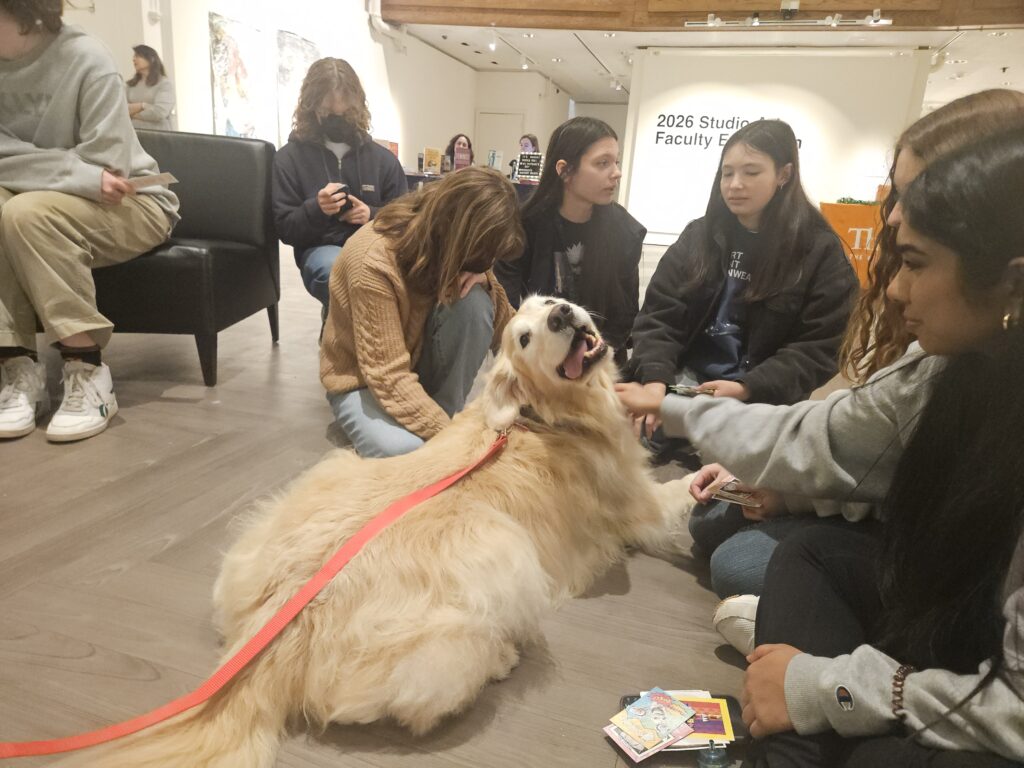
When Laurel Rabschutz started the University of Connecticut’s Paws to Relax program in UConn’s Homer Babbidge Library 16 years ago, she invited students to share comments about their experience. The program brought dogs to the library during finals week, allowing students to take study breaks with the animals.
Rabschutz, who worked at UConn for 30 years in Continuing Education, says students wrote about their favorite visiting dogs and how they wished the event would be held every day. But one comment in particular stuck out to her.
“Somebody wrote: ‘This kept me from jumping out a window,’ ” she recalls.
Rabschutz acknowledges this could have been a joke or an exaggeration, but maybe it was more than that. She says she was touched to think that her idea had made such a difference in someone’s life.
Paws to Relax became an instant success. Rabschutz says the second session of the program in 2010 attracted more than 50 people waiting in the library for her dog’s arrival.
Now, UConn’s program is one of several in Connecticut and many across the U.S. that are geared to college students who may be feeling the stress of taking exams or even living on campus away from their own pets.
Back when she started, Rabschutz says, only a couple of schools across the country were bringing dogs to campuses. Dogs had often been used for therapy, at that time mostly in nursing homes or hospitals.
“We started thinking, ‘You know, students have a lot in common with those people,’ ” Rabschutz said. “They’re in an institution, they’re away from their family, they’re away from their pets. And so it made a lot of sense.”
Seeing the success of the Paws to Relax program, UConn’s Student Health and Wellness – which offers medical, mental health and wellness programs – asked Rabschutz to help make pet therapy a more regular feature on the main campus.
Now, every Tuesday from 4 to 6 p.m., students can head to the Cordial House to experience pet therapy with Rabschutz, her Newfoundland, Ernie, and a variety other dogs. Pet therapy also is offered on campus at The William Benton Museum of Art’s First Thursday event. Meanwhile, Paws to Relax remains a popular feature during finals week and the dogs also visit dining halls and dorms and meet with the athletic teams.
Most of the therapy visits are in group settings, where students are encouraged to sit on the floor and are free to pet, play with and hug the dogs. The dogs often lie on their backs to get some belly rubs, and sometimes even crawl into a student’s lap to take a much-needed nap. Students come and go from the sessions as they wish. At the Benton and Cordial House, one dog at a time typically comes in, with dogs switching out each hour.
Inspired by UConn, other schools in the state, including Eastern Connecticut State University, Central Connecticut State University and the University of Saint Joseph, host dogs almost every week. They don’t hold as many events as UConn, however, Rabschutz says.
Does ‘pet therapy’ reduce stress?
Rabschutz got her Ph.D. in Human Development and Family Sciences with a dissertation about the connection between dogs and the self-esteem and social connection among disabled people. At UConn, she taught a First Year Experience course about the bond between humans and animals. She says it was this experience that pushed her to started advocating for more pet therapy at UConn.
Others have studied the impacts of pet therapy.
In 2015, two researchers at Murray State University in Kentucky found that AAA – or Animal Assisted Activities, including pet therapy – could be “an alternative method of stress reduction at universities and colleges; one that is inexpensive and attractive to much of the college population.”
The study measured psychological stress with a before- and after survey; and physical stress, through saliva samples, from a group of first-year college students, all women. (Researchers say they chose women because they naturally have higher stress levels than men.) Participants gave saliva samples before and after the students either colored quietly or participated in pet therapy. The researchers then measured cortisol, a hormone that’s an indicator of stress in humans.
Both groups saw a drop in psychological stress, but the pet therapy group’s decrease was 63% greater, the study says. Cortisol levels fell for both groups, according to the study.
The researchers concluded that more investigation is needed “to determine the short- and long-term psychological and physiological benefits of AAA with student populations.”
That’s because the research isn’t definitive. For example, a 2008 study indicates any benefits are short-lived: “brief exposure to a pet may have minor or no long-term health benefits as compared to the positive, long term benefits of pet ownership,” while a study conducted in 2007 suggests the opposite.
Rabschutz says other studies bolster the idea pet therapy works, including lowering one’s heart rate. A 2000 study published in the Journal of Psychosomatic Research indicates that “a significant decrease in blood pressure and thus all the other physiological effects can be achieved between five and 24 (minutes) of positive dog interaction.”
Based on her research into the topic and her passion for the animal-human bond, Rabschutz helped found Tails of Joy, an organization of volunteers that provide dog therapy throughout Connecticut. It’s this organization that provides many of the dogs at the UConn events.
Tails of Joy is affiliated with Intermountain Therapy Animals, an organization that registers therapy animals. To become registered, dogs must be at least 1 year old, be in good health, know basic obedience skills and be comfortable interacting with people. The group evaluates the handler and the dog as a team, and they go through a re-evaluation process every two years. The group also may simulate visits during these evaluations, to determine how the dogs and handlers deal with certain situations.
“The dogs have to be comfortable around hospital equipment, walkers, wheelchairs … somebody who’s yelling loudly, people wearing funny clothes or something flying around,” Rabschutz said. They also have to be able to leave food alone if it drops to the floor, she adds.
In its re-evaluations, Intermountain Therapy Animals takes another look at the dogs’ health, ensuring they are still fit to provide therapy. “When the dogs get older, sometimes they might start being a little arthritic or something, maybe they don’t like being petted as much,” Rabschutz said.
The organization also provides insurance for the dogs and handlers should anything go wrong. Handlers are required to keep the dogs on leash and hold onto the leash for the whole session.
Deaf dogs as therapy animals
Jan Proll and her deaf boxer Lucie are Tails of Joy members and are often at the Benton’s First Thursday events. Proll has three dogs – all deaf boxers (white boxers are more prone to deafness than other colors in the breed) – and all therapy animals.
She started her pet therapy journey with her first dog, Sophie, which she enrolled in obedience classes. After those classes were over, Sophie’s veterinarian said she thought the dog would make a great therapy animal. The rest is history.
Now, Proll rotates through her three dogs, taking them each to therapy events at UConn and to K12 schools as well. Proll says everywhere she does therapy, she sees it making a big difference in people’s mental health.
“I think it’s easy for people to relate to dogs,” Proll said. “They open up easily to them and are just very comfortable with them. They don’t have to worry about saying the wrong thing or being poked fun at for being different.”
At April’s First Thursday event, Proll came with her dog Oliver, which took a particular liking to UConn freshman Nalini Coipel.
“I’ve been having a quiet day … maybe Oliver sensed that on me and was like, ‘Let me brighten up her day,’ ” Coipel said. “I think it’s really cute that they can sense that and they can connect with you like that.”
Oliver spent most of the hour he was at The Benton on Coipel’s lap. She says she felt much lighter and stress-free upon leaving than when she did when she arrived.
“I think it’s a really good distraction from everything going on,” Coipel said. “It really is just a dog that’s happy to be pet and I don’t think you have to put much thought into it. You kind of just go and you enjoy that, and you let that dog enjoy you.”
Sandra Lok also comes to First Thursday with her golden retriever, Grant. She says she has two other therapy dogs and rotates which dog she takes to each event.
Students have told her they wished there was a dog at The Benton or in the library all the time. They have even told her they wish a dog could be in the room while they are taking an exam, Lok says.
Lok has taken her dogs to the Paws to Relax program, and says that’s the event where she hears the most meaningful things from students.
“I’ll never forget, one student one time said, ‘Y’ know, I was thinking I couldn’t do my exam, but now I can do it,’” Lok said. “That’s what you want.”
Sometimes, pet therapy can make assignments and exams leave a student’s mind for a time, like it did for Lenin Narvaez, a UConn freshman.
“For the time I was petting the dog, I forgot I had a midterm tomorrow,” Narvaez said.
Narvaez says he hasn’t seen a dog in a long time, so he was glad he was able to come and pet one.
And his friend William Cheshire, also a freshman, says the dog reminded him of his own at home, something that made him happy.
Even students who don’t have pets at home feel like they are benefitting. Lia Wollerman, a junior at UConn, says this was her first experience with pet therapy.
“I don’t have pets, so I usually don’t get to go home and see my dog,” she said.
For the short time he wasn’t in Coipel’s lap, Oliver was lying with his paws on Wollerman’s legs.
“How can you be stressed when you’re looking at him?” she asked. “You get so caught up in talking to the dog in that baby voice and just trying to make them happy that it makes you happy.”
Rabschutz says she wishes more people would research the effects of pet therapy and the animal-human bond, as most of the evidence of its success is anecdotal. But she says that even if someone’s score on a stress survey or their blood pressure doesn’t decrease much after interacting with a dog, it’s what they feel and say that really matters.
“You talk to them and they say, ‘Oh, this made such a difference,’” she said. “So I don’t discount the anecdotal. Students tell us all the time that they love this and they wish they could do it more and they wait every semester for the Paws to Relax to come around. I do think it really does help.”
This story was supported by a grant from the Solutions Journalism Network. UConn Journalism is a foundational member of the CT Student Journalism Collaborative, which was chosen to participate in the Solutions Journalism Network Student Media Challenge cohort for 2025–26.