Spring Valley Student Farm brings fresh produce to UConn
The UConn Spring Valley Student farm hosts a small group of students to work and live at the farm each semester. This slideshow showcases the farmer’s market the group sets up each fall. / Photos, video and sound editing by Emily Sharkis
By Emily Sharkis Feature Writing Class April 28, 2024
Stepping onto the property of the main location of the Book Barn in Niantic, Connecticut feels like entering a new world. Bright red picnic tables, lush greenery, and playground equipment all evoke a sense of childlike wonder. One might think the Barn was a nursery school if not for the main attraction: thousands of used books.
“During the busiest summer buying season, it’s standard for us to purchase anywhere from ten to fifteen thousand books a week,” said longtime Book Barn customer and employee Glenn Shea.
Many bibliophiles enjoy the wide variety of titles. “It’s like a little treasure hunt,” said UConn junior Emily Goodwin, “When I first get [to the Book Barn], I’m not overwhelmed. I feel this boost of joy being surrounded by books. Books just make me so happy because I know that every single one of them can take you away.”
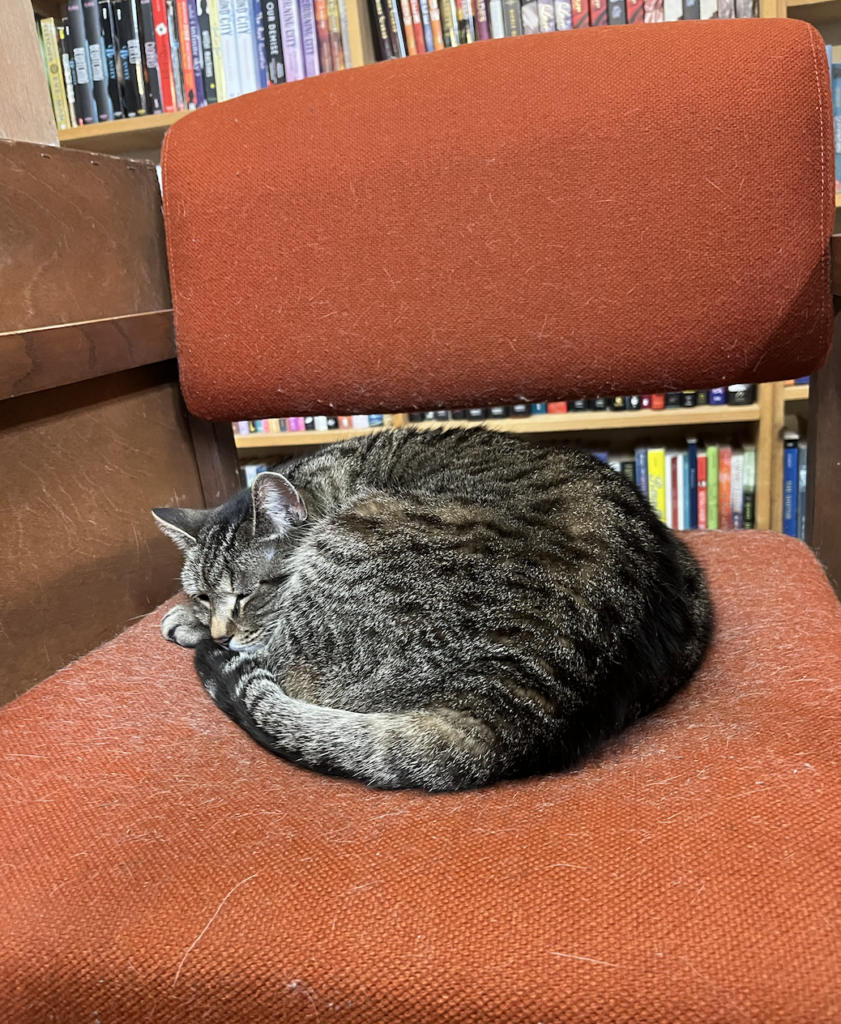
Book Barn resident Cheesepuff sleeps peacefully amongst the books. Photo via Emily Sharkis
While the Barn is known for having one-off copies of rare finds, the young adult section harbors plenty of multiples: rows of John Green novels, dystopian classics, and an entire shelf dedicated to copies of If I Stay by Gayle Forman.
The main building at the Main Barn holds an expansive young adult section, where customers can often find an adorable cat named Cheesepuff.
Goodwin, who just so happens to be my roommate, calls this section her favorite. “It’s very nostalgic for me because it’s all these books that I wanted to read or had read during my childhood,” said Goodwin.
The Book Barn also has two other locations. The Book Barn Downtown is a three minute drive from the Main Barn. Purchased as an overflow space, the Book Barn Downtown is full to the brim with children’s literature, fantasy, and unique titles such as How to Survive a Sharknado and Other Unnatural Disasters by Andrew Shaffer.
Opened in May 2014, Chapter Three sits right down the road from the Main Barn. This cozy spot sells Book Barn apparel and has a focus on romance, entertainment, and military titles. Visitors of Chapter Three are often greeted by the feline trio of cats Rosemary, Thyme, and Cutiepie. The expansive properties and unique quirks make the Book Barn feel like more than just a used book store.
“Many teachers bring their classes to the Barn stores as days out, and because the main property has play areas — swings, a slide, a playhouse, kid cars, a chess set–as well as a supply of cats and goats, they react to the Barn as if they were having recess,” said Shea, “We often hear stories from parents who tell us their child asked to come to the Barn for their birthdays.”
Goodwin first found out about the Book Barn through a Google search last summer. Driving down from the University of Connecticut took my friends and I about an hour, but compared to some of the Barns’ other customers, this distance is relatively short.
“We get visitors regularly now from all over, ranging from a couple who’d driven from Pennsylvania expressly to visit the Barn, to a family I see every year…that live in India, who come to buy books for their kids and bring me the gossip about what’s going on in Delhi,” said Shea.
Part of the reason people travel far and wide for the Barn is that they do not offer any kind of online shopping. When Randi and Maureen White opened the Book Barn in 1988, online bookselling was not nearly as popular as it is now. Plus, “Randi wanted to build the store up to have enough books to draw people in from a distance,” said Shea.
One of the biggest draws to used bookstores is the fact that their stock is often priced quite low. A fact that Shea says could not exist if the Barn went online.
“If we sold online we’d have to raise prices precipitously, as we’d need to hire at least two more people to do the cataloging and mail orders…Because the prices are low we have the best turnover I’ve ever seen in a secondhand bookshop; we regularly cull and dollar old stock. So all of this hangs together: people will come a good distance to find cheap books, we’re the only place locally that offers cash as well as store credit for books, and so all this saves us from having to deal with selling online. Randi didn’t want the best and rarest of our stock going out to someone sitting at home in Nebraska–he wanted to pull people in, and it’s worked,” said Shea.
It’s not just the low prices that draw in customers, however, it’s also the large sense of community that can be felt at all three Book Barn locations.
This sense of community starts with the booksellers themselves. “The emphasis when [Randi and store manager T. Hagan] interview or hire is that we all support each other when someone needs a day off, or has a medical emergency, so on and on. I know this sounds like corporatespeak, but it’s always great to see it in the flesh. I think this is visible to the people who come to visit and shop, and they often become part of the place as well,” says Shea, “I can’t tell you how often, when a customer has asked me a question I can’t answer, the answer has been called out by one of our regular customers, kibitzing from the side.”
As for the future, Shea says he hopes to keep up the good work, without any major changes. “God knows we have enough books, and we have enough customers. If something’s working as it should, you try not to jimmy with it.”
By Emily Sharkis Feature Writing Class April 7, 2024
In 2024, if you glance around a mall, concert hall, or college campus, chances are, you will see at least one piece of fast fashion clothing — often without even knowing it.
According to consulting firm McKinsey and Company, fast fashion is defined as articles of clothing that are rapidly and cheaply produced, often accompanied by strong manufacturer-to ‑consumer supply chains and loyal customer bases.
The fast fashion market is growing quickly, with Statistica predicting that the market value of fast fashion will reach a value of approximately $185 billion by 2027. Just the other day my friend casually mentioned dropping $300 on clothes from Shien, a popular online retailer, for an upcoming vacation.
However, the negative effects of fast fashion are a lot more widespread than many initially realize. Alongside Shien, stores like Forever 21, Zara, H&M, Old Navy, and Urban Outfitters, fall under the fast fashion umbrella.
Although people often deem purchasing fast fashion to be morally wrong, many college students continue to buy from these retailers — myself included. But why? When speaking to some fellow college students, 5 key themes seemed to emerge.
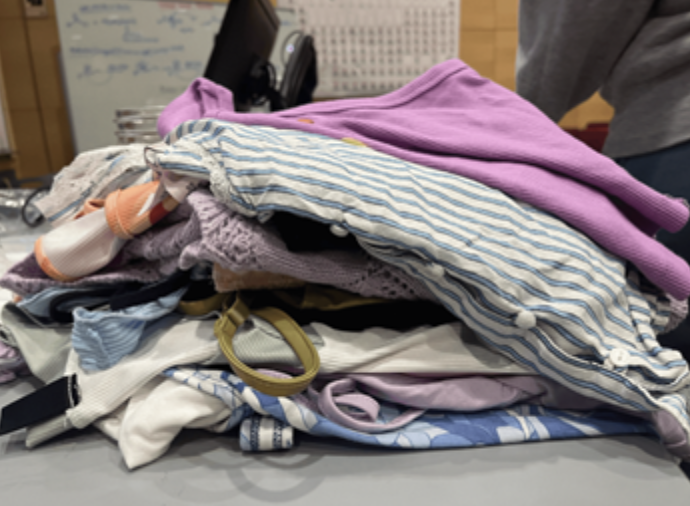
A pile of fast fashion tops sit on top of a desk. The items were donated to Her Campus UConn for the student organization’s thrift shop fundraiser in March 2024. Photo via Emily Sharkis.
It’s Absolutely Everywhere — And It’s Cheap
Fast fashion clothing options tend to be cheaper than clothing from sustainable companies, a fact mentioned by 15 of the 18 people I spoke to. Fast fashion is not only widespread, but it’s often hiding in plain sight.
“Fast fashion is so prevalent we don’t even realize it. Almost every store at the mall is fast fashion no matter the price. Zara for example, is so expensive, but one of the least ethical brands out there. Price doesn’t equal quality, and quality doesn’t equal sustainability,” said UConn junior Maria Ada B.
This prevalence is furthered by fast fashion’s presence on social media. “I see a lot of people on TikTok doing huge (and often sponsored) fast fashion hauls and it really contributes to a strong sense of overconsumption,” said UConn junior Mia Keazer.
It’s Size-Inclusive
“I remember going to the mall with my friends in high school and being so excited to go into Forever 21 because that was the only store that I could actually buy things in,” said UConn Junior Nala Davis.
It’s a frustration I share: many clothing brands simply do not have size inclusive options.
“I’m plus-sized and it’s hard to find anything in my size that’s affordable and is a style that I like. Sadly only [fast fashion] companies check all the boxes,” said Katiely Mercedes, a Junior at Hunter College.
“As a curvy girl, sometimes the sustainable fashion lines do not have my size or are not flattering on me. I know my weight fluctuates and when buying jeans I would rather buy the ones that are less expensive,” added UConn Sophomore Cianna Tangishaka.
Greenwashing
Greenwashing is the practice of making a product or activity appear to be less damaging to the environment than it really is. Greenwashing practices can include a lack of public information, reliance on discredited measurement tools, having unregulated “eco-conscious” collections, and more.
According to the non-profit Greenpeace UK, stores such as H&M, Zara, Primark, and more, are guilty of greenwashing. While greenwashing can be damaging, many people are unaware it is even happening.
“I remember seeing a promotional advertisement about H&M creating an environmentally friendly clothing line, and then researching for a class that this was actually totally false (at least back then). Almost any company can claim “clean & sustainable fashion” through plain imagery of green leaves/recycling logos on the tag to imply clean fashion without actually claiming it,” said UConn senior Elizabeth Agarunova.
“I used to work for Uniqlo, and I would notice how many shipments would come in…from third world countries, and the amount of waste within the shipments despite the company’s claims of caring for the environment. Out of curiosity, I searched it up and they’re a greenwashing fast fashion company, and their prices seem to tell people otherwise. I realized price really doesn’t dictate” Mercedes added.
Trends Move So Fast
One of the biggest advantages of fast fashion companies is their wide variety of styles and large number of new designs per day. However, with these seemingly nonstop new items, trends move so fast, making it almost impossible to keep up. This has only encouraged a culture of consumerism and overconsumption.
“Our society values keeping up with the fashion of today so much that stepping outside of that mindset can feel like social death to an extent,” said UConn Graphic Design student Caroline Strapp.
This issue is especially prevalent in college, where having both a professional and party wardrobe and staying on-trend are the norm.
“I had gotten a whole bunch of going out tops and by the time I tried to wear them people had stopped wearing that style of top,” remembers Buffalo State freshman Allie Cigna.
Some people also mentioned needing quick and quality outfits for concerts, Halloween, and other special occasions.
“I think the way we will see the most change in regards to this topic will be when the culture shifts to value our environment and health more than money and material items. The United States lives and breathes capitalism and the pillars of that belief system directly oppose those who value sustainability and socially conscious initiatives. Until there is a culture shift in values we will continue to see this battle between ethics and greed,” said Strapp.
While buying fast fashion can seem inevitable, there are still ways to cut down on consumption.
Go Thrifting
Shopping at thrift stores is a fun and easy alternative to purchasing from fast fashion companies. According to Capital One Shopping’s 2024 Thrifting Report, “83% of Gen Z consumers have either purchased or are interested in secondhand apparel, 10.7% more than the average for all age groups.”
Re-Wear Old Clothes
Try to end the cycle of endless consumption, what eBay calls “single-season wear,” by mixing and matching to create new outfits or simply keeping and actually wearing the clothing you already own. Amy Bannerman, eBay’s Pre-Loved Style Director, suggests dyeing old clothing and layering different pieces to keep your closet fresh.
While it might be nice to tell people to shop more sustainably, marketers and onlookers must remember the reasons why young people turn to fast fashion. Relative to fast fashion, sustainable fashion’s high price point and non-inclusive sizing just isn’t for everyone — at least not yet.
By Emily Sharkis The Daily Campus March 7, 2024
I’m sitting in McHugh 101 watching some movie that’s required for my Univ 3820 class. It’s incredibly dark, the only light coming from the screen. Suddenly, a door creaks open, light pouring in as a red and blue silhouette ducks into the room, quickly looks around, and ducks out. I laugh and shoot my friends a look as if to say “Was that him?” They all smile, confirming my suspicions. UConn Spider-Man is in the building.
It has been almost two years since UConn Spidey first appeared in Storrs, yet I have only seen him in person a handful of times. The seemingly confident man was often surrounded by groups of starstruck fans, yet his motivations and day-to-day life had always been somewhat of a mystery to me.
For two years I had thought about what I would say to Spidey if given the chance. I was about to hop on a Zoom call with him.
Using Instagram DM’s, Spidey and I had set up a time to chat. However, as I sat in the empty Zoom room I wondered if I had gotten the time wrong.
“Holy shit, I am so sorry I forgot,” Spidey texted me three minutes after our set time, “I’ve been cramming for exams.”
I laughed at the relatable message and suddenly, Spidey felt like less of a celebrity and more like a peer.
“No worries, I totally get it,” I responded, trying my best to seem “chill” in front of what some have called a “campus legend.”
“Let me just make sure my roommate doesn’t walk in…he doesn’t know,” replied Spidey.
The second Spidey joined the call, I disregarded all of my prepared questions, excitedly asking “Your roommate doesn’t know? How does that work?”
“Yeah. I mean, it’s hard keeping a secret like that. I had a different roommate when I first started this, so he does know but he hasn’t told anyone… my new roommate doesn’t know,” Spidey explained, “He’s not really much of a social person, so I kind of doubt he’s heard of me.”
Spidey went on to explain the hidden “go bag” he keeps in his closet.
“If I ever need to put on the suit or someone needs something, I quickly go back to my room and grab my other backpack. It’s got everything I could need. My suit, the mask, the face shell. It’s got wipes in case it’s dirty. It’s got like a stick of gum for breath, just like anything I could need in that moment, it’s there.”
“But why Spider-Man as opposed to other superheroes?” I asked.
“It was the easiest. It doesn’t have a face. You know, you could get a suit anywhere. But I also grew up with Spider-Man too, so he very easily became the first choice. And I mean everybody likes Spider-Man.”
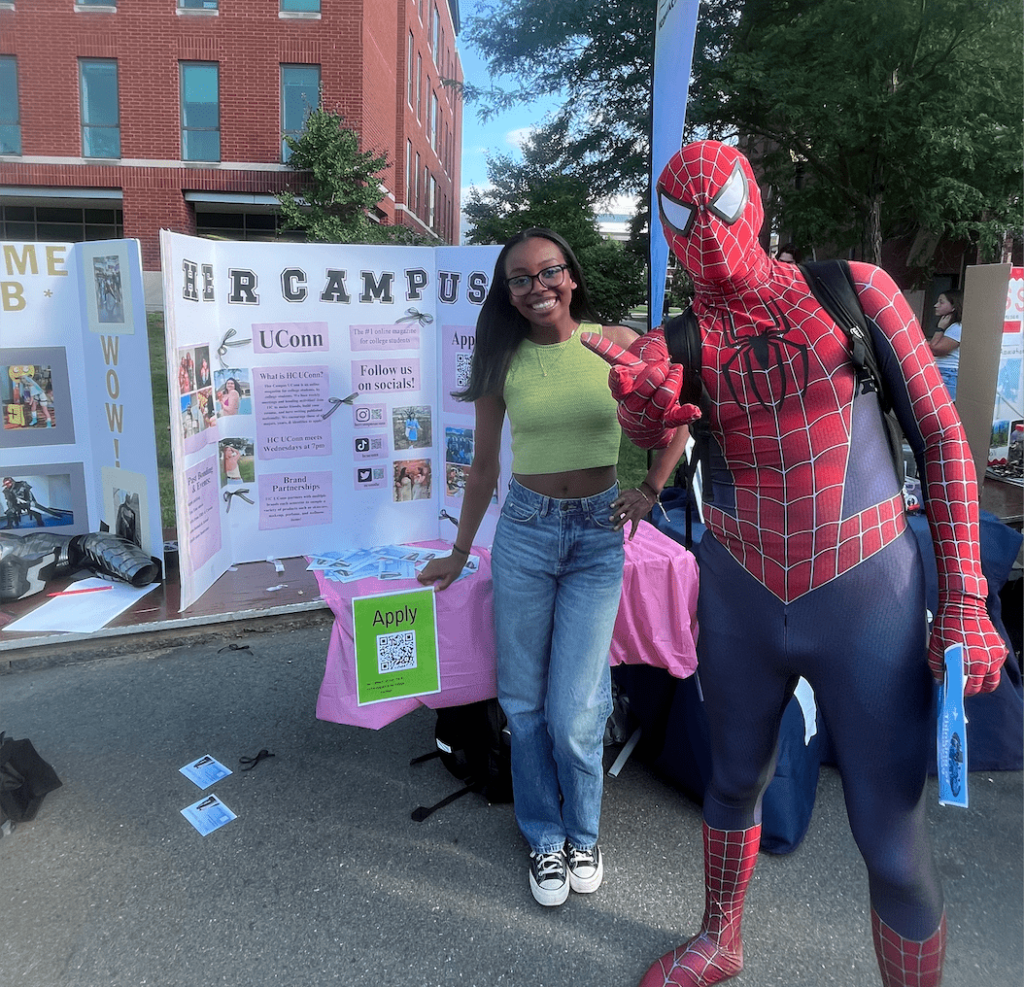
UConn Spider-Man poses with UConn junior Sydney Haywood at the fall involvement fair on Sept. 4, 2024. Photo by Emily Sharkis
UConn, in particular, seems to love Spider-Man. This popularity is best exemplified by a time he attempted to walk past Gampel Pavilion.
As is normal for basketball season, the street surrounding Gampel Pavilion was lined with students hoping for basketball tickets.
“The lines were long and I mean like around the corner, in every exit kind of long and everyone was cheering for the basketball team,” recalls Spidey.
However, as he turned the corner the crowd of students began cheering Spidey’s name instead.
“The craziest part was that people actually got out of line to come take a picture with me and then went to the back of the line because they valued that picture more than the basketball game. It wasn’t even like two or three. I had like a line of like 40 people, like immediately. Thank God I had a mask because I was crying, taking all these pictures.”
While his main goal is to make people smile, Spidey has also been involved in more serious efforts, such as standing up against the homophobic street preachers that frequent UConn’s campus.
According to an article from WHUS Radio, the presence of street preachers at UConn goes back at least a decade. When they showed up on Sept. 28, 2022, Spidey knew what he had to do.
First, he told his boss he needed an hour off to complete a job interview.
“Fucking lie straight up,” Spidey revealed, “I had to get out there. That was one of the times I felt the most loved by the campus. I felt like an avenger walking in.”
While Spidey is certainly a symbol of hope and joy, he also wields a lot of power, a fact he learned while attending his second protest.
While standing in the hot sun, Spidey noticed the crowd starting to get violent.
“I very quickly realized my role in the situation. I was like, although I may disagree with the preachers here, like fundamentally, there’s no reason to fight them. We don’t want to get the police involved here,” said Spidey.
“It’s funny,” I added, “Because I imagine people would be like ‘Spider Man save us!’ And then they’re like…wait.”
“You’re not wrong. People did that,” Spidey began, “But I realized that when I was shouting at them, the crowd got really excited and they began, you know, almost trying to fight these guys.”
Not wanting to be the reason for violence, Spidey decided to step away from the energized crowd and stand in silence.
“The crowd sort of just followed what I did…it was really strange,” said Spidey, “but it was worth it because eventually the preachers walked away.”
One of Spider-Man’s biggest appeals is that while he web-slings throughout New York City, underneath the mask, he has a somewhat regular life. While UConn Spidey is no different, staying anonymous is something he is sure about, at least for right now.
“Maybe when I graduate I will [reveal my identity],” said Spidey, “At the same time, I don’t really want to be known for it. I like the idea that it could be anybody, that it is just an anonymous guy trying to be nice and help out people…I’d hope to have it revealed in a dramatic way though.”
“Well, no matter how you do it, I’m sure people would be really excited,” I told him.
“I hope people don’t see me and they’re like damn, he’s ugly…that’s part of why I’ve just been so secretive. I’m not ready to be judged by the internet. I’m shy as shit in real life as it is,” Spidey said.
Spidey considers himself to be a regular student, balancing work, studies, and being a superhero. He’s even changed his major multiple times. The hardest part, he says, is living a double life.
“[When] my friends are like, ‘how was your weekend,’ I’d have to be like, ‘Oh, it was boring,’ but really I was like a frat rager…at some points, I got confused as to who I was and I got frustrated because I couldn’t share the experiences that I wanted to at the expense of the secret identity,” said Spidey.
While Spidey has successfully remained anonymous for close to two years, there have certainly been close calls.
“I was studying with this group of people and I had to leave in a few hours because someone else wanted to do an interview for a podcast thing. [When] I was heading over to the podcast room, this woman started calling my name. I turn around and it’s the woman I was just studying with. And I was like, oh fuck, this is it’s game over. This is where I get revealed…all she wanted was just a picture and then she walked away…I thought that might have been game over, but no, it was okay,” recalls Spidey.
Looking toward graduation, I asked Spidey about the legacy he wants to leave behind.
“I hope that the people I had experiences with keep them in their heart and move forward in the same way I do and for those who see me, just think back and laugh and take a minute away from the harsh reality of school and education, and stress and exams and just remember that there’s a dude in a Spiderman suit just chilling,” said Spidey.
Do you think you’ll try to recruit someone to take over [after you leave]? I asked.
“I don’t know. It’s hard because at its best, this is a great way to socialize and at its worst, it’s cheesy. You need someone who is willing to do it and not take the fame for it…I haven’t really found that person yet,” he explained.
While Spidey is a humble individual, there is no doubt that he has reached a certain level of fame on UConn’s campus. He’s even dealt with imitators.
“One person told me that some guy tried to claim that they were me and pick up [a girl]…and I just I was like…what woman is going to be like, Oh, that’s so hot. You’re Spider-Man,”Spidey joked.
Rutgers University faculty go on strike for the first time
April 10, 2023 | Updated 10:29 AM
Thousands of faculty members from New Jersey’s Rutgers University went on strike Monday, April 10, causing class cancellations and picket lines. Three faculty unions representing about 9,000 faculty members at the New Brunswick University authorized the strike after contract disputes, ACCORDING TO WHO? PIX 11 News?
WHO POSTED THIS VIDEO? WRITE A CAPTION, GIVE CREDIT, INCLUDE DATE IT WAS POSTED.
“We are fighting for better work conditions for our faculty so that students’ learning conditions can be improved,” Media Studies Professor Deepa Kumar told NBC New York.
Rutgers said in a statement [LINK TO THE STATEMENT] Sunday night that they were committed to ensuring that the academic progress of students was unaffected by the strike.
However, by Monday morning picket lines were being set up throughout Rutgers’ campuses in New Brunswick/Piscataway, Newark and Camden. According to the Associated Press, most classes were still being held, while some were canceled due to the strike.
In a tweet on Sunday night, New Jersey Governor Phil Murphy invited representatives from both the university and union bargaining committees to his office to negotiate and have a “productive dialogue.”
Rutgers University is one of the nation’s premier institutions of higher learning. I am calling the University and union bargaining committees to meet in my office tomorrow to have a productive dialogue. pic.twitter.com/KTDmpm3LKD
Negotiations were expected to begin Monday afternoon, Rutgers AAUP-AFT General Vice President Todd Wolfson told NPR.
“We feel hopeful about bargaining productively, and we appreciate the governor’s support,” Rebecca Givan, president of one of the Unions, told the New York Times.
You must be logged in to post a comment.