By Sara Bedigian
UConn Journalism
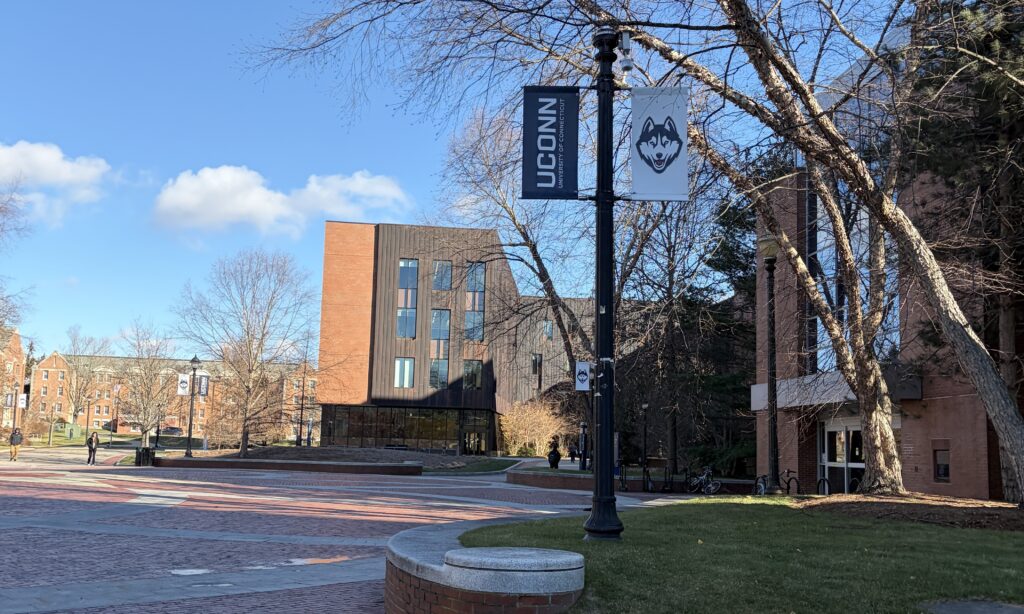
Higher education has been considered a pillar of scientific research, drug discovery and technological innovation that has fueled the American knowledge economy.
This is one of the nation’s greatest strengths — but it is being undermined as never before by the federal government, said Tom Katsouleas, an engineering professor and the former president of the University of Connecticut.
“I would say that the U.S. higher education system is the envy of the world,” said Katsouleas, who co-signed a May 2025 op-ed in the Washington Post with other former university leaders blasting the federal administration’s attacks on higher education. “And we are essentially as a government killing the goose that’s laying the golden egg.”
The first year of President Donald Trump’s second term brought significant challenges to higher education institutions, as the administration canceled billions of dollars in research grants and pressured universities to adopt ideological changes, such as eliminating DEI programs and limiting international students. The actions have raised concerns in Connecticut, home to 36 colleges and universities, and across the U.S. about the future of academia.
Jeffrey Dudas, a professor of political science and president of the UConn chapter of the American Association of University Professors, said federal funding has been invested in universities for decades, whether directly funding research programs or covering some of the indirect costs, such as infrastructure that makes the research possible.
“When you threaten that, you are threatening so much, not just the immediate beneficiaries of those grants, but also the future landscape of academia,” Dudas said.
The federal government has been outsourcing research to universities for decades rather than creating large bureaucratic structures and federal agencies. Through federal funding to support university research, the government is paying a lot less than if the research was being done in-house, Dudas said.

“They don’t have to create their own labs. They don’t have to go out and hire their own people,” Dudas said. “This has been a very good deal for the nation, and a very good deal for the federal government.”
To have this relationship threatened is extremely unsettling, Dudas said.
At their core, the Trump administration’s actions are an attempt to influence ideology on university campuses and make it more reflective of the president’s priorities.
Jay Bergman, a professor of history at Central Connecticut State University and adviser to the university’s chapter of the conservative group Turning Point USA, said he agrees with Trump that colleges skew to the left.
As a conservative professor at CCSU, Bergman said he feels significantly outnumbered by his liberal colleagues. When faculty express their political views in the classroom, it makes this division worse, Bergman said.
Bergman’s views are shared by many Republicans. In a 2018 Pew Research survey, about eight in 10 Republicans said professors bringing their political and social views into the classroom is a major reason why the higher education system is going in the wrong direction. Only 17% of Democrats agreed.
“I believe that the corruption and the rot in academia is so deep that one can’t reasonably expect universities to reform themselves,” Bergman said. “As a result, we need external pressure — whether it’s from state legislatures, governors or the Trump administration.”
The history of higher ed
From the beginning, the original role of universities was to be repositories of knowledge to pass on from generation to generation, Katsouleas said.
In the U.S., the first universities were private, starting with Harvard University, before public schools developed in the early 1800s.
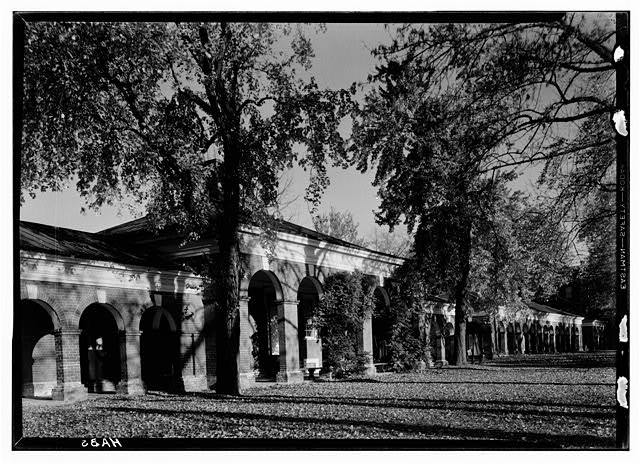
“Thomas Jefferson notably created University of Virginia with a different purpose — not as a repository of knowledge, but as creating an educated citizenry that he thought was essential to successful democracy,” Katsouleas said.
Through the Morrill Act of 1862, Congress created land grant universities that were focused on supporting workforce development and farmers with agricultural technology.
In Connecticut, UConn was one of those schools — a farm school, founded in 1881, to provide real-world agricultural education.
During World War II, universities got involved in the development of radar and nuclear weapons, using their knowledge to create innovative discoveries for the nation. Following the war, Congress created federal research agencies including the National Science Foundation and the National Institute of Health.
“The role of universities changed now from repository of knowledge to creators of new knowledge. And so that was a major shift,” Katsouleas said.
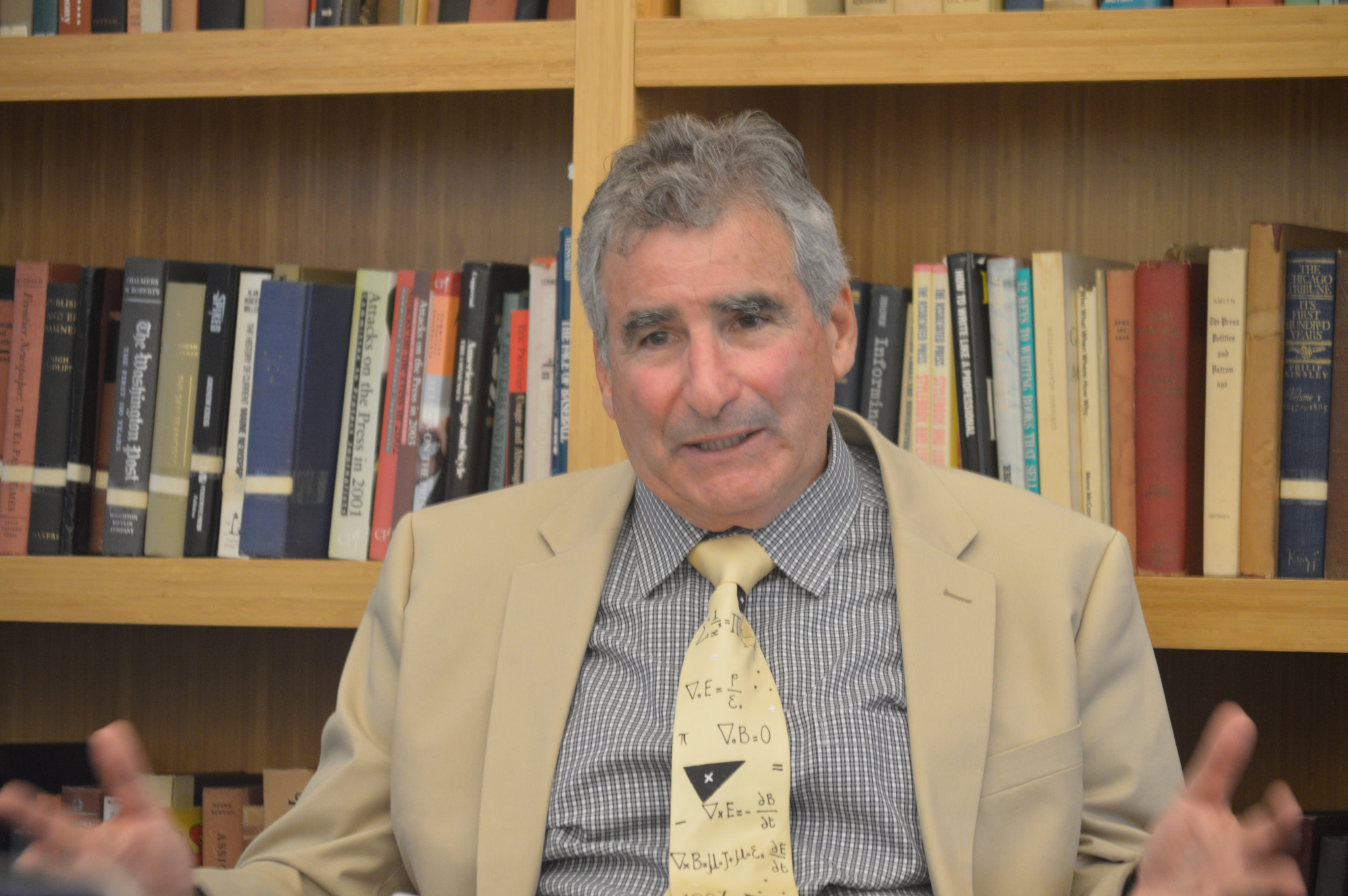
Tom Katsouleas, the former president of the University of Connecticut. Katsoleas explains the history of higher education in the U.S. Photo by Elijah Polance
In 1980, the Bayh-Dole Act legalized and encouraged universities to patent their research discoveries, leading universities to become not only sources of discovery, but also engines of innovation, translating that discovery into products, services and devices.
The invention of the internet, computer, nuclear medicine and space travel have been directly connected to university research.
“Universities have played a critical role in the fact that the United States is the leading economic and military power in the world,” Katsouleas said. “I would argue that higher education has become the United States’ most successful industry.”
Over the last several years, there has been a shift toward a less favorable view of higher education. A 2019 Pew Research Center survey found that only half of American adults think colleges and universities are having a positive effect on the country and about 40% said they are having a negative impact, up from 26% in 2012. When asked whether the U.S. higher education system is going in the right or wrong direction in a 2018 Pew survey, 73% of Republicans said it was going in the wrong direction, compared to 52% of Democrats.
Katsouleas said polls started showing less favorable views of higher education a decade ago due to beliefs that higher education was for the elite, did not include people from diverse backgrounds and was liberal leaning.
The attack on higher education today
Today, higher education institutions are facing unprecedented pressure from the federal government as the Trump administration pushes for changes in policies to reflect ideological goals.
A variety of executive orders have sought to change accreditation, increase federal oversight over admission practices to eliminate race-conscious admissions and require schools to report foreign financial ties.
In addition to executive orders, the administration has cut federal funding through agencies such as the National Science Foundation, National Institutes of Health and National Endowment of Humanities that do not support Trump’s priorities or viewpoints.
Content-specific cancelations have been implemented by agencies like NSF and NIH by combing through titles and descriptions of active research projects to determine if they include activities that violate Trump’s executive orders, such as words relating to DEI.
Schools around the U.S. have been impacted directly by these cuts. In Connecticut, UConn has lost $41 million from research grant terminations and unexpected non-renewals as of Oct. 15, according to Lindsey DiStefano, interim vice president of research.
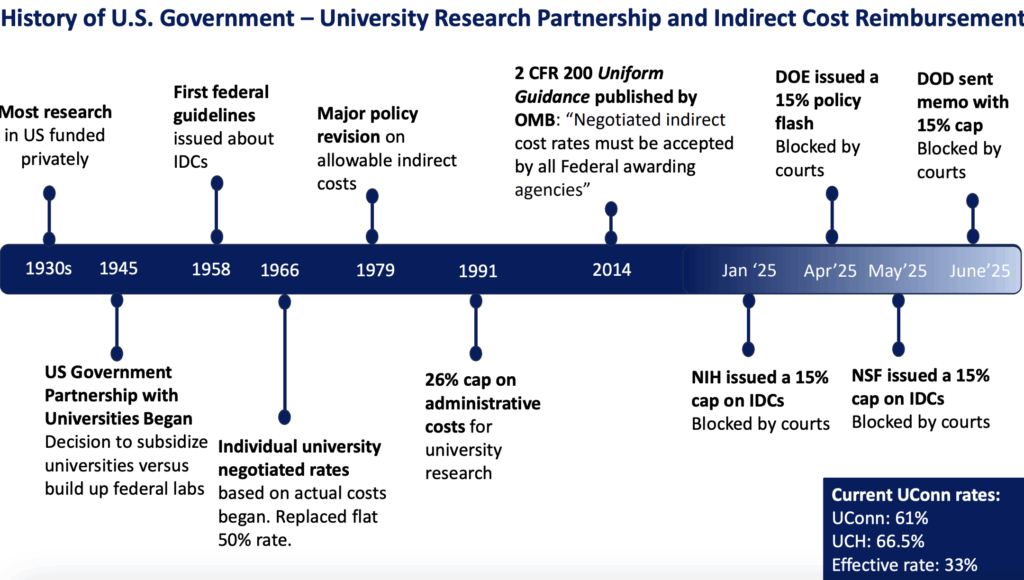
The administration has also targeted indirect cost rate reimbursements for federal grants — negotiated rates with the government to reflect the total cost of doing research, including funding utilities, building maintenance and research administration. While it varies per university, pre-negotiated rates range from 30% to 70%, according to a Library of Congress report published in May 2025. Early last year, federal agencies released statements that would impose a 15% indirect cost rate on all awards to universities, according to policy notices from NSF and NIH.
This was met with lawsuits from state officials and universities prohibiting them from implementing the rate reduction. As proceedings continue, Congress could decide to respond through oversight or legislation, according to a Library of Congress report published in December 2025.
If the 15% rate is implemented, that could cause a university to experience a shortfall, Katsouleas said.
The Trump administration has used threats to federal funding and discrimination lawsuits to target specific universities, too – among them some of the top research universities in the country. Schools such as Harvard, Columbia and UCLA have faced criticism from the Trump administration over alleged antisemitism and DEI programs.
In March 2025, the Trump administration threatened to cut federal funding to Columbia University, alleging antisemitism during pro-Palestinian protests. Trump has stated generally that all federal funding will be revoked for any college or university that allows “illegal” protests.
In July, Columbia agreed to pay $200 million to settle claims related to discriminatory practices and increase oversight on international student admissions, according to a White House statement.
The administration has also cut billions of funds to researchers at Harvard, attempted to restrict international student programs and threatened the school’s tax-exempt status, according to a White House statement and Truth Social posts from Trump in spring 2025.
Harvard sued in response in April. While a federal judge broadly ruled in Harvard’s favor and funds returned to the university in September, the freeze had a significant impact on research, according to the Harvard Gazette, the university’s news source, and the Harvard Crimson, the student newspaper.
In July 2025, the Trump administration froze over $300 million in research grants to the University of California, Los Angeles and sought a $1.2 billion fine over the university’s diversity programs. A federal judge blocked the fine in November, according to the Los Angeles Times.
In October 2025, the Trump administration offered a deal for prioritized funding to nine other universities that he hoped would agree with his priorities. “A Compact for Excellence in Higher Education” required universities to support ideological conditions such as limiting international students, requiring standardized testing, eliminating DEI initiatives, restricting employees from expressing political views on behalf of the institution and shutting down departments that go against conservative ideas.
Schools including the University of Arizona, Brown University, Dartmouth College, Massachusetts Institute of Technology, the University of Pennsylvania, the University of Southern California and the University of Virginia have rejected the compact, according to the New York Times.
Bergman said he is in support of Trump’s compact letter and believes the changes are necessary in the current “corrupt” state of higher education.
“I think the compact simply requires universities to do what universities are required to do, which is to educate students, rather than to indoctrinate them, so that when they graduate, they are knowledgeable in American history and political institutions and Western civilization and so that they can act as responsible citizens in a democratic society,” he said.
No schools in Connecticut had received the compact letter offer as of the end of 2025.
U.S. Sen. Chris Murphy, a Democrat from Connecticut, said the letter and Trump’s other directives impacting higher education are attempts by the president “to bully university officials into suppressing criticism.”
“The president is in the process of destroying the knowledge economy and the research economy,” Murphy said.
Katsouleas said the impacts could be felt long-term in Connecticut and throughout the U.S.
“Eventually this is going to lead to shortages of doctors, nurses, teachers, journalists, engineers, accountants and other professionals upon which we rely for our way of life,” Katsouleas said.
You must be logged in to post a comment.