By Julia Casola | University of Connecticut
May 27, 2026
Connecticut libraries are facing growing financial pressure as demand for e‑books and audiobooks surges, with librarians saying they are paying significantly higher prices for digital materials they don’t permanently own.
Connecticut libraries currently spend about $7 million annually on e‑books and audiobooks, Ellen Paul, the executive director of Connecticut Library Consortium, said. Dawn La Valle, the director of the Division of Library Development at the Connecticut State Library, said a typical print book costs libraries about $15 while an e‑book license can range from $56 to $78.
Erin Dummeyer, the president of the Connecticut Library Association and the director of Mark Twain Library in Redding, said many e‑book licenses expire after two years or after about 26 checkouts, requiring libraries to repurchase the same title to maintain access.
“So if we wanted to keep it in our collection after it expires, we would again have to spend between $50 and $60 on that license,” Dummeyer said.
Dummeyer said these pricing models directly affect patrons, often resulting in long wait times or limited availability.
“It hasn’t stopped climbing, and trying to rein in our spending on e‑books is one of our greatest challenges,” Dummeyer said. “People love e‑books, and we want to give them what they love, but the way publishers create these pricing models is not sustainable for libraries.”
Although lawmakers passed a bill in 2025 to address these costs, the law has not taken effect, leaving libraries to continue operating under what many describe as unsustainable pricing systems, library directors across the state said.
The law will prohibit libraries from entering into e‑book and digital audiobook licensing agreements that limit access through expiration dates or checkout caps. It is intended to prevent publishers from requiring libraries to repurchase digital titles after a set number of uses or years, according to the legislation.
But the law includes a trigger provision and will only go into effect if another state passes similar legislation to bring the combined state population to a total of seven million people, La Valle said.
“As of now, the legislation has been adopted, but it’s not enforced,” La Valle said.
Illinois, Massachusetts, Rhode Island, Missouri, Tennessee and New Jersey have bills that are moving through their legislatures which could eventually trigger the Connecticut law when passed, La Valle said.
Kate Byroade, the director of Cragin Memorial Library in Colchester and the co-chair of the Connecticut Library Association’s Legislative Committee, said the issue has been building for years as demand for digital materials has surged.
“The e‑book issue has been an issue basically for as long as e‑books have been available and widely popular,” Byroade said.
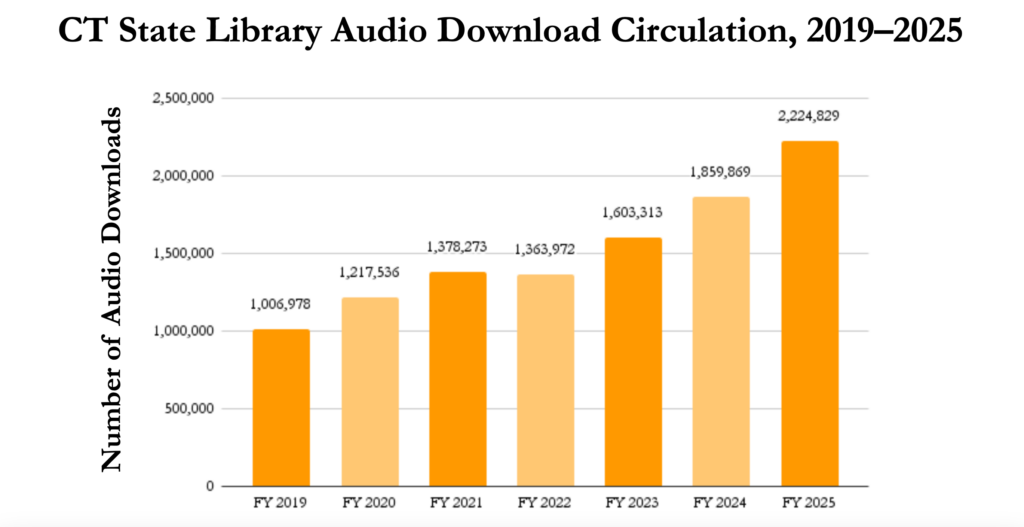
Electronic materials now account for 23% of total library circulation in Connecticut as of fiscal year 2025, up from 10.3% in 2019, according to a state library report. Audio downloads have also increased 19% over the past year and more than 120% since fiscal year 2019, according to the report.
Margaret Khan, the director of Booth & Dimock Memorial Library in Coventry and the treasurer of the Connecticut Library Association, said her library sometimes pays about five times what a consumer would pay for the same e‑book.
“Sometimes, it is about $80 for an e‑book, and that has a limited number of circulations,” Khan said.
Paul said libraries are often forced to make purchasing decisions based on demand rather than collection building.
Some popular titles can have dozens of patrons waiting for a single digital copy, which may expire before all users can access it, she explained.
“Libraries are buying into the holds list,” she said.
E‑book expenses are also affecting academic institutions, Paul said.
“Even though the institution is paying for access, they are severely limited in their ability to interlibrary loan that resource to another campus,” Paul said. “That’s inhibiting the core mission of the library: to share information and these resources.”
In some cases, Khan said, people may forget they have a hold placed, and this can irritate other patrons.
“There is frustration, oftentimes, with the wait times for materials,” Khan said. “By the time you’re on the list, it might not even be available anymore.”
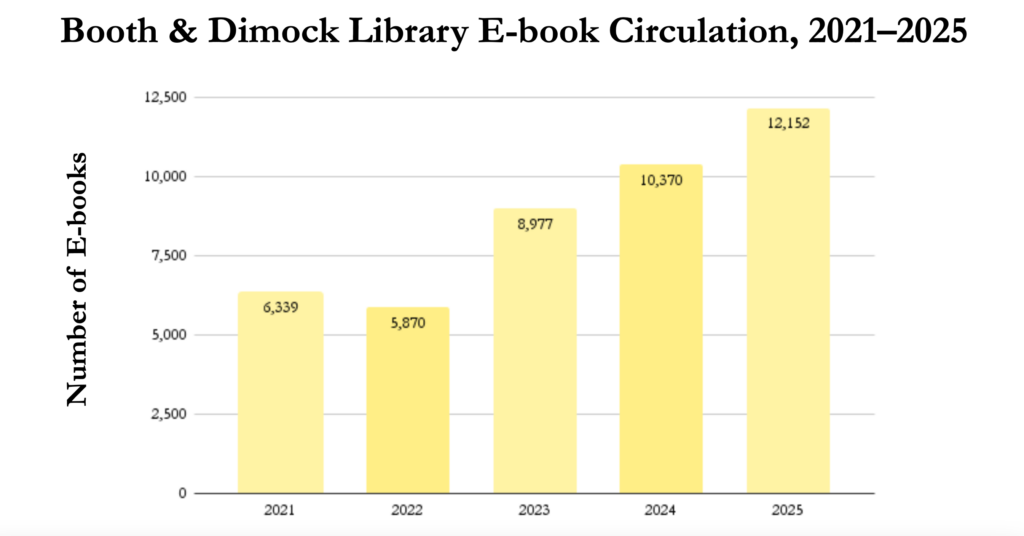
At the Booth & Dimock Memorial Library, total electronic circulation increased from 6,339 in 2021 to 12,152 in 2025, Khan said.
Dummeyer said her library circulated more than 21,000 digital items last year despite serving a population of fewer than 9,000 people.
Jennifer Johnston-Marius, the library director of Rockville Public Library in Vernon, confirmed that e‑book usage at her library continues to grow each year.
Johnston-Marius said the library recorded more than 10,000 checkouts in 2025 through Libby, an app that allows patrons to borrow e‑books for free through public libraries.
Despite the growth, Johnston-Marius said maintaining access to popular titles is increasingly difficult due to the cost.
“I can’t justify this many copies because it’s also a flash in a pan and in eight months, everybody will have read it, and they’ll move on,” Johnston-Marius said. “It’s a really frustrating setup, how we are struggling to keep up with the demand, but the cost is just so high.”
Rebecca Harlow, the head of reference and adult services at Case Memorial Library in Orange, said the pricing model also limits access for patrons who rely on digital formats.
“We want to provide access to people with print impairments, including those who rely on audiobooks or cannot easily use physical books,” Harlow said. “But many of those needs are not being met because of the way publishers structure these licensing models.”
Publishers and industry groups, however, argue that the legislation could have unintended consequences for authors and readers.
Kathryn Rexrode, chief communications officer for the Association of American Publishers, said publishers raised concerns throughout the legislative process and sought to find a solution.
“When a new movie is released, the government does not force it to be immediately made available for free on a public streaming platform, without just compensation for its creators,” she said in an emailed statement.
“This law’s profound disregard of author rights would grant the government an alarming power to decide which books are accessible to Connecticut readers and jeopardize library access to digital books,” Rexrode said.
Despite those concerns, publishers have not engaged in discussions with libraries about changing current pricing or licensing models, according to Paul.
“There have not been any publishers who have come to the table,” Paul said “Specifically, there have not been any of the Big Five publishers who have come to the table and said, ‘Let’s talk this through. Let’s come to a solution on our own, rather than going this legislative route.’”
Paul said it is unclear how publishers will respond if the law takes effect and added that legal challenges are likely.
“If this bill is triggered, we fully expect it to be challenged in court,” Paul said. “I am fully confident that this will withstand any legal challenge.”
This story has been updated to include comment from the Association of American Publishers.