According to Article 1, Section 9, the U.S. has no king and can never name a king. U.S. officials are barred from accepting gifts or titles from foreign states without congressional consent.
Despite this, President Donald Trump has repeatedly made comments about being a king or being immune from the law. University of Connecticut political science professor Virginia Hettinger said that Trump’s rhetoric, while it doesn’t signal a constitutional crisis, could have long-term effects on democracy.
“It might be a signal of significant and potentially long-term damage to democracy,” she said. “It might represent a dramatic departure from the political system in which we’ve all lived our entire lives.”
U.S. Sen. Chris Murphy, a Democrat from Connecticut, warns that the country is in the middle of an authoritarian takeover.
“I think some people think that there’s a day when democracy dies, and sometimes there is,” he said. “Sometimes there’s a coup in which, you know, the President gets executed, gets hung from the gallows, and your democracy is over. You know, in some places, elections get canceled, right? So you just stop having them. That’s not what’s going to happen in America. We’re going to still have elections next November. The question is whether they’re free and fair elections.”

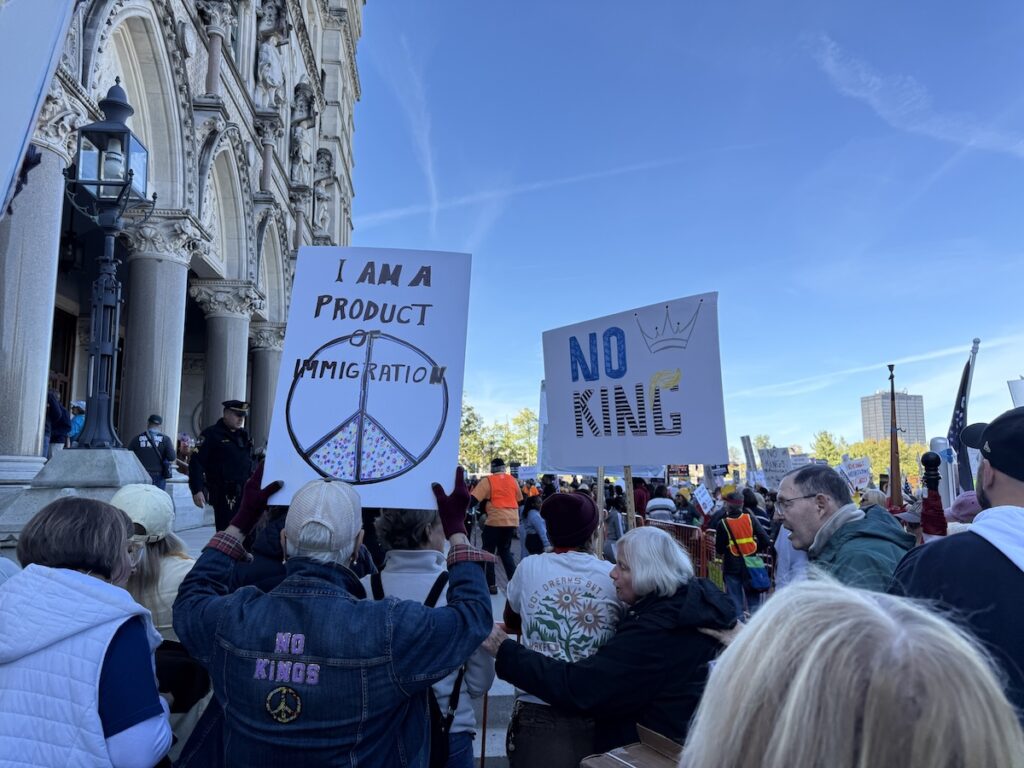
Across the country, Americans have been participating in “No Kings” protests against Trump. Jonathan Alter, a former senior editor and columnist at Newsweek and longtime political analyst for NBC and MSNBC, said that the protests helped Americans focus on Trump’s monarch-like actions.
“It was a brilliantly designed protest because the phrase ‘no kings’ is broad enough to bring a lot of people together who might disagree on other issues, but understand that our society, our country, was founded on the idea of no kings,” he said.
Alter said that with an estimated 7 million protestors, the October “No Kings” protest, held in locations throughout the country, was collectively the second largest protest in American History, only beaten by Earth Day 1970. Despite the large numbers, Alter said the protests won’t make immediate change, but that they are causing Trump’s approval numbers to start slipping.
“A lot of times people go, ‘what good did [protesting] do?’ I’m sure there were kids in UConn who were saying that nothing changed, but that’s not the way protest works,” he said. “It’s movement building, and it’s cumulative so that, over time, he loses his legitimacy and loses his hold over the country.”
The second round of “No Kings” protests held Oct. 18, 2025, included a gathering of thousands at the Connecticut State Capital in Hartford. Protestor Melia Bensussen said that she was protesting because people deserve to know the truth about what their government is up to.
“No king means that you don’t redistrict for voting, you don’t make it so that no real information is distributed. It’s no fascism. It’s saying people need to be able to vote on facts and know the truth. And this government is not doing that,” she said.
Protestor Miguelina Howell said that that she believes decision-making power in the U.S. is meant to be left to the masses, not one person or government.
“To me, ‘no kings’ means share power. Share decision-making processes. We are a democracy. We are a country that makes decisions in layers. We do not have a king. ‘No kings’ means the power is in the people,” she said.
—by Mikayla Bunnell, UConn Journalism. Karla Perez and Lily Goldblatt contributed reporting to this article.
You must be logged in to post a comment.